
Asscher Cut Diamond: How to Judge the Cut Before You Buy
Learn how to compare an Asscher cut diamond’s light pattern, proportions, clarity, color, dimensions, grading report and setting.
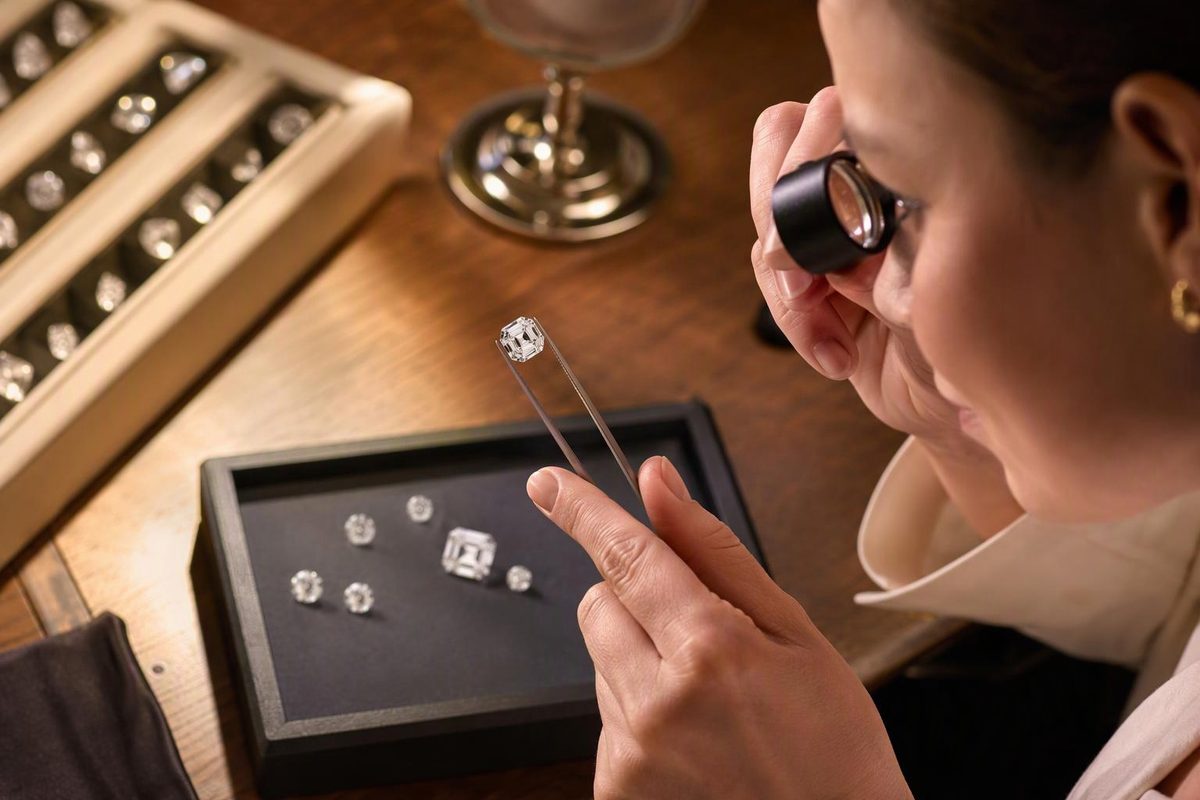
An Asscher cut diamond is a nearly square step cut with cropped corners and concentric rows of broad facets. Instead of the rapid sparkle of a round or princess cut, it produces alternating flashes and dark reflections—the “hall of mirrors” effect associated with step cuts.
That geometric look is the reason to buy one. It is also why grades alone are insufficient: GIA does not issue an overall cut grade for an Asscher. Videos, dimensions and direct comparison matter more than a seller’s “ideal” label.
What makes an Asscher cut different?
Joseph Asscher developed the original cut in 1902. GIA describes it as a 58-facet design with large, widely spaced facets and a nearly octagonal outline; it later became associated with Art Deco jewelry. Generic Asschers vary because cutters choose different angles and proportions (GIA).
An Asscher can be confused with other square diamonds:
- Princess cut: usually has pointed corners and brilliant-style faceting, producing smaller, faster flashes that can conceal inclusions better.
- Square radiant: has cropped corners but brilliant-style faceting, often with a busier or “crushed ice” appearance.
- Emerald cut: uses similar step facets but normally has a rectangular outline.
The laboratory report may describe an unbranded Asscher-style stone as a square emerald cut or cut-cornered square step cut. Match the report number and measurements to the diamond rather than relying on the listing name.
A Royal Asscher Cut is a branded variation, not simply a quality grade for a generic Asscher. Royal Asscher says its patented design has 74 facets and proprietary proportion requirements, compared with 58 facets in the original design (Royal Asscher). Treat any premium as a decision about that particular brand and design; facet count alone does not establish which diamond you will prefer.
Judge the pattern because there is no overall GIA cut grade
GIA currently gives an overall cut grade only to round brilliants. Fancy shapes receive separate polish and symmetry grades, but these do not assess total face-up light performance (GIA). “Excellent cut Asscher” on a listing is therefore a seller’s classification, not a GIA cut grade.
Use the grading report to screen candidates, then assess these features in images and video:
- A centered, balanced pattern. Look for evenly nested steps and a crisp central X. The four sides should mirror one another rather than appearing twisted or lopsided.
- Active contrast. Dark facets are normal and help define the pattern. As the stone or camera moves, they should switch between light and dark rather than leaving broad areas persistently black, gray or glassy.
- Brightness across the stone. Check whether the corners and outer steps participate or form a consistently dull border.
- An outline you like. Divide the report’s length by its width. A result of 1.00 is mathematically square; higher figures are increasingly rectangular. Personal preference matters more than an arbitrary “ideal” ratio.
- Competitive face-up dimensions. Asschers commonly have deep pavilions, so equal-weight stones can differ in visible length and width. Compare millimeter dimensions, not carat weight alone.
Table and depth percentages can identify candidates worth viewing, but no single proportion recipe guarantees an attractive Asscher. GIA likewise advises comparing fancy shapes visually because it does not grade their overall proportions (GIA).
How much color and clarity do you need?
Step cuts reveal body color and inclusions more readily than brilliant cuts because their facets are larger and more open (GIA). GIA suggests VS2 clarity or higher and G color or better as a starting point for Asschers, particularly above 2–3 carats, but these are screening suggestions—not guarantees or mandatory minimums.
For clarity, compare individually verified VS and SI stones rather than automatically paying for VVS. Ask for a face-up video at realistic magnification and check the report’s plot and comments for:
- a dark crystal beneath the table;
- a large inclusion reflected repeatedly through the steps;
- clouds accompanying an overall hazy appearance;
- a feather or other surface-reaching inclusion near the girdle.
The last point deserves professional review if the inclusion is substantial. GIA notes that some surface-reaching inclusions near the girdle can increase vulnerability if struck, although the nature, size, depth and location all matter (GIA). A clean-looking SI1 may be preferable to a visibly included VS1, while an obvious central inclusion can remain distracting despite an “eye-clean” sales description. See the diamond clarity scale before paying for a higher label.
For color, compare diamonds face-up and from the side in neutral lighting. White gold or platinum can make warmth more apparent by contrast, while yellow or rose gold may integrate it into the design. Larger diamonds and color-sensitive buyers may prefer a higher grade; other buyers deliberately choose warmth for a vintage appearance.
Fluorescence is not automatically a defect. GIA found that it does not itself cause haziness, although it can intensify a pre-existing transparency problem in rare cases. Inspect a strongly fluorescent diamond under daylight-equivalent illumination rather than rejecting it from the report alone (GIA).
Compare an Asscher online
Request a neutral, high-resolution video showing the loose diamond face-up and tilting slowly through several angles. Diffused, office-like illumination is more informative than spotlighting alone. If possible, ask to see two Asschers of similar weight, color and clarity under the same lighting and camera exposure.
Check that the report number and measurements match the listing. For a GIA-graded diamond, GIA Report Check confirms whether the supplied report information matches its database. If the diamond has a laser inscription, ask the seller to verify it under magnification before shipping. An inscription helps link a stone to report data; it does not establish value or confirm that the seller’s images show the same stone unless someone checks it.
The report should also identify whether the diamond is natural or laboratory-grown and note detected treatments. Compare like with like because the two origins occupy different markets.
Choose a setting that keeps the geometry visible
Prongs placed at the cropped corners can preserve the octagonal outline. Double claws add a period look and are often used on larger Asschers. A bezel gives the girdle more protection, but its width and shape determine how much of the outline remains visible. A halo increases the ring’s total footprint but may compete visually with the center’s quieter pattern.
Before approving the setting, provide the jeweler with the stone’s exact measurements and request a rendering or written plan for prong placement. Heavy prongs can make the outline read as a plain square. If the ring will sit beside a wedding band, also confirm whether a straight band will fit flush or whether the basket requires a curved or contoured band.
A practical buying order
- Decide whether you prefer broad, architectural flashes to brilliant-cut sparkle.
- Set the diamond origin, total budget and approximate millimeter-size target.
- Filter by a reputable laboratory report, color and clarity, keeping the initial ranges broad.
- Compare face-up dimensions and outline.
- Shortlist by the moving light pattern—not the seller’s cut label.
- Inspect inclusions, girdle condition and transparency at high resolution.
- Verify the report, return period and which shipping or setting charges are refundable.
- Have the finished ring inspected while it can still be returned.
The best Asscher is not automatically the whitest or clearest candidate. It is the one with a balanced, active pattern, acceptable visible color and clarity, and enough face-up size to justify its price.