
What Is a Good Carat Size for an Engagement Ring?
Start by trying 0.75–1.50 ct, then compare appearance, comfort and total ring cost. Learn why carat weight alone cannot tell you how big a diamond looks.
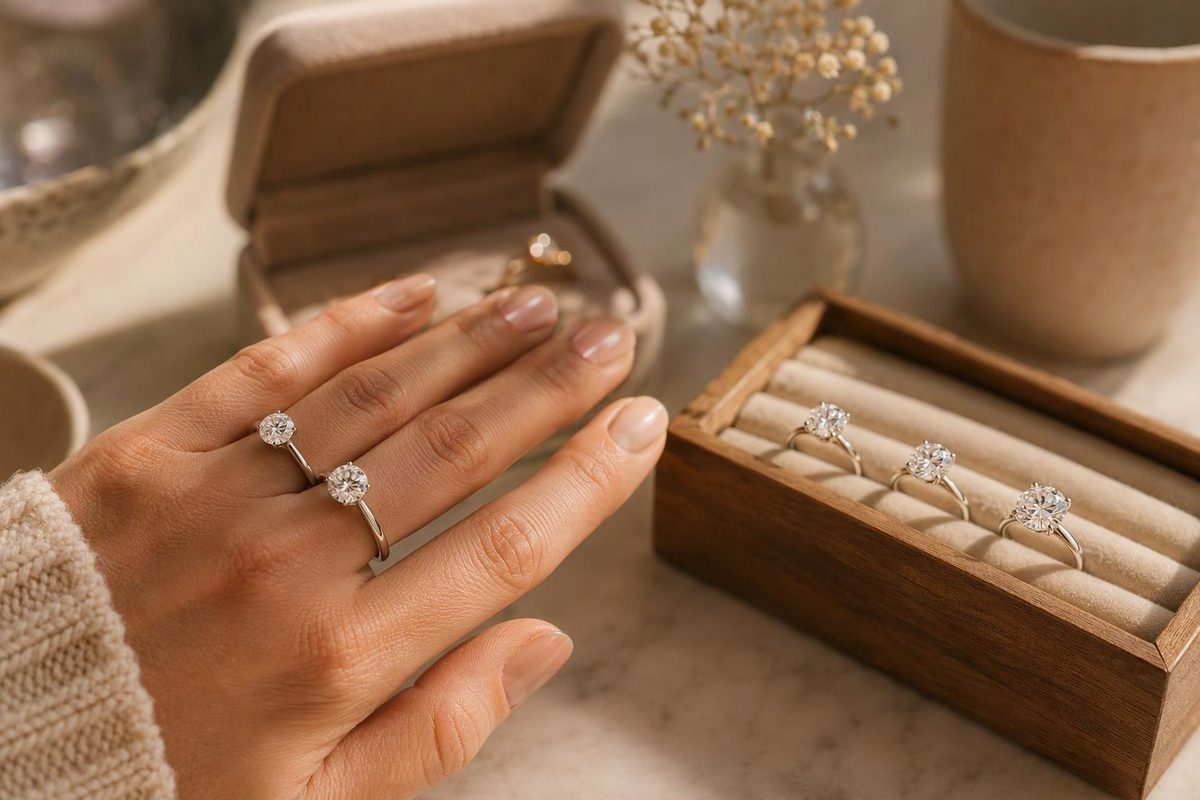
For a diamond engagement ring, 0.75–1.50 carats is a useful starting range to try on—not a minimum, an average or a rule. If you have no size preference yet, begin with a 1-carat center stone, then compare a smaller and a larger option in similar settings.
A good size is the one the wearer likes on their hand, can wear comfortably and can afford without sacrificing the diamond’s appearance or the ring’s construction. A half-carat ring does not need an apology; a 2-carat ring is not automatically a better choice.
Choose a starting range, not a target you must reach
Use these as try-on suggestions rather than fixed descriptions of how every ring will look:
| If the wearer wants… | Start by comparing… |
|---|---|
| A restrained look | 0.50–0.75 ct centers |
| A middle ground between subtle and prominent | 0.75–1.50 ct centers |
| A deliberately prominent center | 1.50–2.00 ct or larger centers |
There is no carat-to-ring-size formula that determines what looks “right.” Compare rings on the intended finger, ideally with the planned wedding band. Look at the whole hand from a normal viewing distance, not only in a close-up photograph.
For a surprise proposal, the wearer’s existing jewelry and stated preferences are more useful than someone else’s size standard. If those give you little guidance, agree on a style together or choose a seller with suitable written return terms.
Carat weight is not visible size
Carats measure weight: 1 carat equals 0.20 grams. A diamond’s millimeter dimensions tell you more about its visible footprint. A deep diamond can carry extra weight below the girdle without looking larger from above, as GIA explains in its carat-weight guide.
Before comparing two stones, ask for:
- The center diamond’s exact carat weight.
- Its length, width and depth in millimeters.
- Face-up photographs or video at a comparable scale.
- A view of the finished ring from the side.
Shape and setting also change the impression. Elongated shapes such as ovals and marquise diamonds can look larger for their weight; a halo can accentuate the apparent size of the ring’s top. These are visual effects, not increases in the center stone’s carat weight. GIA discusses these shape and setting differences.
If you are considering a larger center, use our 2-carat diamond dimensions by shape to make a millimeter-based shortlist.
Keep appearance ahead of the round number
Do not accept a dull-looking stone simply to reach 1 or 2 carats. Cut quality affects how a diamond returns light. Even standard round brilliant diamonds with the same GIA cut grade can have different face-up appearances. GIA recommends examining diamonds under different lighting conditions, rather than relying on jewelry-store spotlights alone.
Our buying priority is straightforward: first find an appearance you like, then decide whether the extra size is worth the extra cost. Inspect visible color, inclusions and sparkle rather than paying for weight or grades in isolation.
For natural diamonds, also compare stones just below a milestone weight—for example, 0.90–0.99 ct against 1.00 ct or more. GIA identifies popular weights as “magic sizes” with price-per-carat increases. That makes below-threshold stones worth checking, not guaranteed bargains: compare actual dimensions, quality and asking prices.
If diamond origin is flexible, review the 1-carat lab-grown versus natural price comparison before setting your weight target.
Check the finished ring before committing
Carat weight alone does not tell you whether a ring will suit daily wear. During a try-on, check the setting’s height, contact with neighboring fingers, comfort when making a fist and compatibility with the wedding band. Ask the jeweler about secure construction for the chosen stone—not merely whether it can fit in the mounting.
Finally, confirm whether an advertised weight means center-stone weight or total carat weight. Total carat weight combines all the diamonds in the piece; a 1-carat-total ring need not contain a 1-carat center. GIA makes this distinction explicit.
Request an itemized finished-ring quote, including the center, setting, side stones and applicable taxes or fees. Choose the preferred ring within that total budget—not the largest loose diamond the budget can barely cover.