
Diamond vs Moissanite in Sunlight: What to Look For
Moissanite usually shows more rainbow fire in sunlight. Compare both stones in direct sun and shade—and learn why sparkle cannot prove identity.
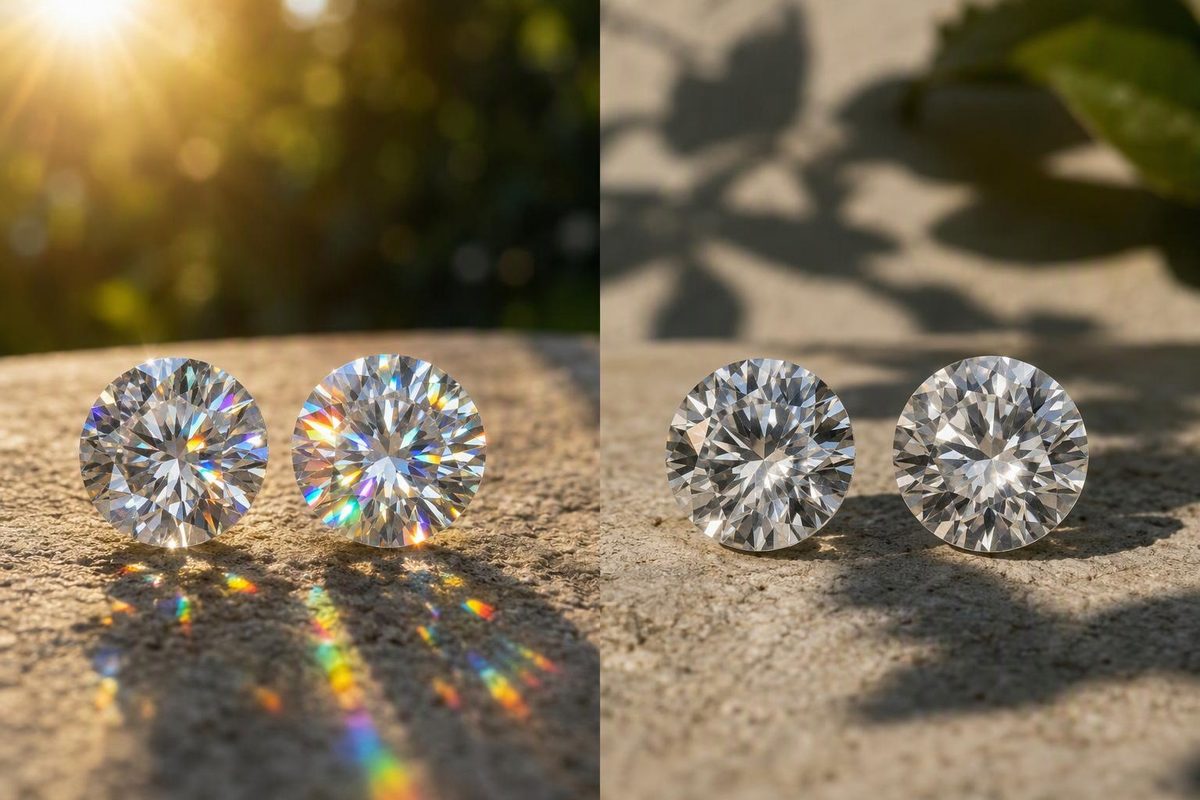
Moissanite generally shows more pronounced rainbow flashes than diamond in sunlight. Diamond also produces rainbow fire, so “rainbows mean moissanite” is not a reliable test. The useful buying question is whether you prefer the balance of colored flashes, brightness and contrast in the particular stones you are comparing.
GIA identifies moissanite’s much higher dispersion—the splitting of light into spectral colors—as a reason for its more obvious fire. That is an optical difference, not a verdict that one stone is more beautiful. GIA’s comparison of moissanite and diamond also makes clear that moissanite is a different material, not a type of diamond.
What changes outdoors?
Separate three features that sellers often bundle together as “sparkle”:
- Brightness: the white light the stone returns to your eye.
- Fire: the colored flashes produced when light separates into its spectrum.
- Scintillation: the flashes and changing pattern of light and dark as the stone, observer or light moves.
These are distinct aspects of appearance. More fire does not automatically mean a brighter stone. Facet arrangement, proportions and lighting affect the result; GIA recommends viewing diamonds in different environments rather than judging them under store lighting alone. GIA’s guide to light and diamond appearance explains these distinctions.
Direct sun: compare colored flashes and contrast
Tilt both stones slowly. Look for the size, frequency and intensity of colored flashes—not simply whether rainbows appear. Moissanite’s higher dispersion makes stronger rainbow fire more likely, but it does not guarantee that every moissanite will look more attractive than every diamond.
Do not expect either stone to remain evenly bright at every angle. A diamond reflects its surroundings, including your face and the camera. Dark areas can therefore be part of the viewing pattern rather than evidence of dirt, poor clarity or a substitute stone. GIA demonstrates how bringing a diamond closer to your eye can enlarge those dark reflections. How light and viewing distance affect a diamond.
Open shade: compare the overall appearance
Move away from direct sun while remaining outdoors. Use this second view to judge overall brightness, visible body color and any persistent dull-looking areas without concentrating only on dramatic flashes.
Direct sun and shade answer different questions. A stone you enjoy for its rainbow display may look less compelling to you in softer light—or the reverse. Neither view should stand in for the lighting where you will usually wear the ring.
A blue appearance is not the same as rainbow fire
Some diamonds fluoresce when exposed to ultraviolet light from sources such as the sun, usually emitting blue light. Fluorescence is a separate effect from dispersion.
Do not assume that fluorescence means a diamond will look cloudy. GIA reports that fluorescence does not cause haziness by itself, though it can intensify pre-existing haziness associated with rare light-scattering defects. Inspect the actual stone in daylight rather than rejecting it solely because its report records Strong or Very Strong fluorescence. GIA’s fluorescence guidance.
How to make a useful side-by-side comparison
- Match shape and face-up dimensions as closely as possible. This reduces size and design differences that can distract from the material comparison.
- Compare clean stones in the same conditions. Hold them side by side, at the same distance and angle, rather than comparing separate seller videos.
- Check direct sun, open shade and ordinary indoor lighting. For an online purchase, request those views of the actual stones and confirm the return terms.
- Start at normal wearing distance. Decide whether you like the appearance before looking for tiny differences under magnification.
- Keep identity verification separate. Moissanite can show doubled facet junctions under suitable viewing conditions, but that is a gemological inspection clue—not a dependable sunlight test. GIA’s research on synthetic moissanite documents both doubling and its diamond-like thermal response. A thermal-only diamond tester can also leave uncertainty. If the material’s identity is uncertain, have a qualified gemologist confirm it before buying.
If pronounced rainbow fire is what you enjoy, moissanite deserves consideration. If you prefer a particular diamond’s pattern, choose it for what you can see—not because someone has told you diamonds only flash white.