
Lab-Grown Diamonds Usually Pass Diamond Testers
The shared thermal response explains why, but an ordinary tester cannot reveal natural versus lab origin or always rule out moissanite.
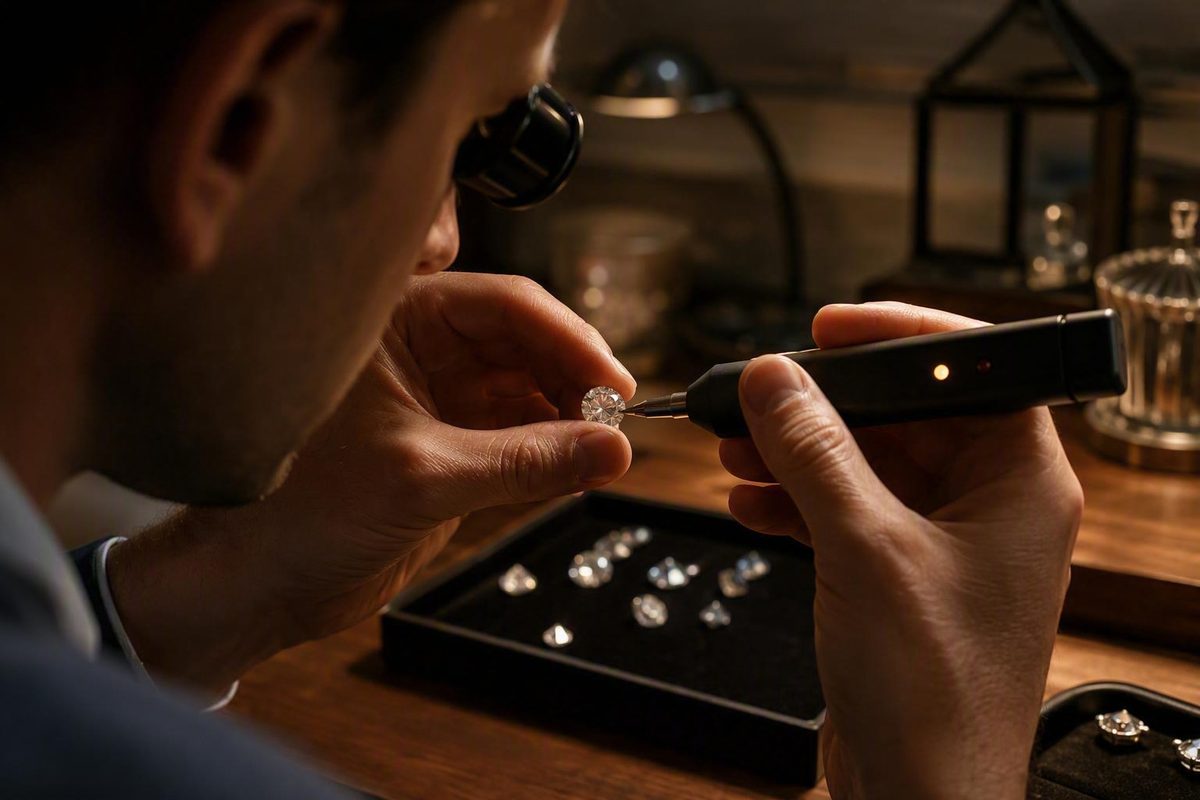
A diamond reading confirms less than you may think.
The short answer: lab-grown diamonds usually pass
Yes. A laboratory-grown diamond will usually register as diamond on a conventional thermal-conductivity tester. Natural and laboratory-grown diamonds are both crystallized carbon and have essentially the same chemical, physical, and optical properties for ordinary testing purposes. The Gemological Institute of America (GIA) confirms that both are diamonds, while noting that specialized equipment can detect subtle growth-related differences (GIA’s comparison of natural and laboratory-grown diamonds).
That positive reading has a narrow meaning: the stone produced the conductivity response that the device associates with diamond. It does not reveal whether the diamond formed naturally in the earth or was grown in a laboratory.
This distinction matters because a laboratory-grown diamond is not a diamond simulant. It is diamond material produced through a technological growth process. Moissanite, cubic zirconia, and white sapphire are different materials that can resemble diamond but have different physical and optical properties.
On an ordinary thermal testing pen, the expected results are therefore:
- A natural diamond usually registers as diamond.
- A laboratory-grown diamond usually registers as diamond.
- The readings generally look the same.
- Neither result establishes growth origin, quality grade, or report identity.
“Usually” is more accurate than “always.” Results can vary with the device, its condition and settings, the size and cleanliness of the stone, whether the stone is mounted, probe contact, and user technique. A negative, moissanite, or fluctuating result calls for controlled follow-up; it is not immediate proof that a documented stone is not diamond.
The practical answer to “Do lab grown diamonds pass a diamond tester?” is therefore yes, normally. But if the question is whether that test can prove a diamond is laboratory-grown rather than natural, the answer is no.
What a handheld diamond tester actually measures
The familiar diamond tester is generally a small electronic probe shaped like a pen. Despite its name, it does not directly read a gemstone’s geological or manufacturing history. It measures one or more physical properties and compares the result with the ranges the device is designed to recognize.
A basic thermal tester places a heated probe against the gemstone. The instrument evaluates how quickly heat moves away from the tip and through the stone. Diamond conducts heat unusually well, so a sufficiently strong response causes the tester to indicate “diamond” or move into a diamond range. Commercial testing guidance describes this as a useful first-stage distinction between diamond and lower-conductivity simulants, while warning against relying on the pen alone (Do Amore’s diamond-tester overview).
Natural and laboratory-grown diamonds normally produce comparable thermal responses because they share the crystal structure and heat-conducting behavior of diamond. The tester is responding to the material in front of it, not determining where that material grew.
Some testers also assess electrical conductivity. This feature is generally intended to improve the separation of diamond from moissanite, which can resemble diamond on a thermal-only instrument. A tester that combines heat and electrical measurements may be described as dual-mode or multi-testing.
Even then, the display remains a screening signal. The pen does not conduct a complete chemical analysis, assign a quality grade, or examine the microscopic growth structures that can reveal natural or laboratory formation. Unless it is a purpose-built origin-screening instrument, an electrical test does not turn it into a reliable natural-versus-laboratory-grown detector.
Laboratory-grown diamonds are principally produced by two methods:
- HPHT: high pressure, high temperature
- CVD: chemical vapor deposition
Both processes create diamond through different growth routes. GIA identifies HPHT and CVD as the principal laboratory-growth methods and explains that trained gemologists can detect subtle differences with appropriate equipment. An ordinary testing pen should not be expected to identify either process.
A careful reading of a handheld tester result is:
“This stone behaved like diamond under the property measured by this device.”
It is not:
“This device has proved the stone’s material, origin, quality, and documentation.”
Thermal, dual-mode, and origin-screening tools are not interchangeable
“Diamond tester” is a broad term applied to tools that answer different questions. A consumer thermal pen, a jeweler’s dual-mode tester, a specialized origin screener, and a gemological laboratory examination should not be treated as equivalent.
| Tool type | Property examined | Useful screening purpose | Main limitation |
|---|---|---|---|
| Thermal-only pen | Rate at which heat moves through the stone | Helps separate diamond-like high thermal conductivity from many lower-conductivity materials | May identify moissanite as diamond; does not determine natural versus laboratory-grown origin |
| Electrical or dual-mode tester | Electrical conductivity alone, or electrical plus thermal conductivity | Improves diamond-versus-moissanite screening compared with heat alone | Conductive diamonds and testing variables can complicate results; not a conclusive origin test |
| Specialized origin screener | Depending on the instrument, fluorescence, phosphorescence, spectral response, imaging, or growth-related signals | Screens for indicators associated with natural, HPHT, or CVD formation | May flag or refer a stone rather than resolve every case |
| Gemological laboratory analysis | Multiple methods such as microscopy, spectroscopy, photoluminescence, ultraviolet imaging, and growth-pattern analysis | Investigates material identity, treatments, and growth origin using several lines of evidence | Requires specialized equipment and interpretation; not equivalent to a quick pen test |
A thermal-only pen is most useful as a preliminary elimination tool. A low-conductivity response may help rule out diamond under appropriate test conditions, while a high-conductivity response narrows the possibilities. It does not close the case because moissanite may also trigger a diamond result.
A dual-mode instrument adds information by comparing electrical behavior as well as heat transfer. That can improve diamond-versus-moissanite screening, but “improve” does not mean “guarantee.” Device design, thresholds, stone characteristics, probe placement, and operating conditions still affect the result.
Origin-screening instruments belong to another category. Depending on the system, they may examine fluorescence or phosphorescence, analyze spectral features, use deep-ultraviolet imaging, or reveal growth patterns. These observations can provide evidence about how a diamond formed. GIA’s central guidance is that traditional observations and old-style diamond detectors cannot reliably separate laboratory-grown diamonds from natural ones; trained examination and purpose-built equipment are required.
Screening also differs from determination.
The performance of one commercial screening machine should not be generalized to every instrument. The useful questions are:
- What property does this model examine?
- Is it testing material identity or growth origin?
- What result categories can it return?
- What stone sizes and settings can it handle?
- Does a flagged result require laboratory referral?
Expected results for diamond, moissanite, cubic zirconia, and white sapphire
The following matrix summarizes typical, not guaranteed, results on a basic thermal-conductivity pen:
| Stone | What it is | Typical thermal-pen result | How to interpret it |
|---|---|---|---|
| Natural diamond | Naturally formed crystallized carbon | Diamond | Expected, but does not prove natural origin |
| Laboratory-grown diamond | Crystallized carbon grown by HPHT or CVD | Diamond | Expected, but does not prove laboratory origin |
| Moissanite | Silicon carbide | May register as diamond | Heat-only result is inconclusive; use electrical and optical follow-up |
| Cubic zirconia | Zirconium dioxide | Usually does not register as diamond | Consistent with CZ or another lower-conductivity material, subject to testing conditions |
| White sapphire | Corundum | Usually does not register as diamond | Generally lacks the thermal response required for a diamond indication |
Natural and laboratory-grown diamonds normally give the same thermal result because the pen measures a shared material property. Unless the instrument includes purpose-built origin-screening technology, its display contains no reliable natural-versus-laboratory-grown category.
Moissanite is the important complication. It is silicon carbide rather than diamond, but its high thermal conductivity can trigger a thermal-only pen. A positive thermal reading therefore narrows the possibilities without proving that the tested stone is diamond. Commercial testing guidance consistently presents the pen as one stage of identification rather than a final verdict (Do Amore on what passes a diamond tester).
A dual-mode tester can improve this separation by adding electrical conductivity. If the device indicates moissanite, however, confirmation is sensible when the stone has important documentary or financial implications. Conductive diamonds, setting interference, and testing technique can complicate a one-step conclusion.
Trained optical examination can add another line of evidence. Moissanite is doubly refractive, whereas diamond is singly refractive. Under suitable magnification and viewing conditions, a knowledgeable examiner may see doubling of certain facet junctions in moissanite. Rare Carat discusses both the conductivity limitation and double refraction as parts of follow-up identification (Rare Carat on lab diamonds testing as moissanite).
Cubic zirconia and white sapphire generally do not move heat away from the probe rapidly enough to produce a standard thermal pen’s diamond indication. This makes the pen useful for preliminary screening against those materials. But an expected result can still be undermined by contamination, inadequate contact, incorrect settings, equipment problems, or unsuitable stone size.
Read the result as a decision aid:
- Diamond reading: consistent with natural diamond or laboratory-grown diamond, but possibly moissanite on a thermal-only pen.
- Moissanite reading: may indicate moissanite, but confirm it if the stone is documented as diamond.
- Negative reading: may indicate a lower-conductivity material or a testing problem.
- Inconsistent readings: stop drawing conclusions until the instrument and testing conditions have been checked.
Why a genuine lab-grown diamond may read as moissanite or fail
An unexpected result can be unsettling, especially when the diamond came with a grading report. But the first conclusion should not be that the stone is fraudulent. The device, the testing conditions, the setting, or the stone’s electrical behavior may explain the conflict.
Practical causes of unreliable readings include:
- A weak battery or insufficient charge
- Failure to follow the required warm-up procedure
- Incorrect calibration, mode, or sensitivity
- An old, damaged, or poorly maintained tester
- A probe held at an unsuitable angle
- Inadequate contact between the probe and stone
- Contact with a metal prong, bezel, or other part of the setting
- Dirt, oil, lotion, or residue on the stone
- A stone too small for reliable contact with that tester
- Limited access to the stone in mounted jewelry
- User error or misreading the display
Mounted stones are especially difficult to test. If the tip touches metal instead of the gemstone, the result may be misleading. Commercial tester guidance specifically identifies low batteries, metal contact, device condition, and user technique as potential causes of false readings (Mikado Diamonds’ testing overview).
Some commercial sources also report anomalous electrical-conductivity results in certain HPHT-grown or boron-bearing diamonds. Boron can make diamond electrically conductive, and natural boron-bearing blue diamonds may also complicate conductivity-based testing. Rare Carat uses these exceptions to caution against treating an electrical response as proof of laboratory origin.
The supplied evidence does not establish how frequently these exceptions occur, which consumer tester models are most affected, or one mechanism that explains every reported misclassification. Claims involving boron, metallic inclusions, growth characteristics, impurities, and device limitations should therefore remain qualified.
In particular:
- Not every HPHT diamond will read as moissanite.
- A moissanite reading does not prove HPHT growth.
- A diamond reading does not prove CVD growth.
- Electrical conductivity alone does not prove laboratory origin.
- A negative result does not automatically override matching documentation and professional examination.
Treat the anomalous reading as a conflict to investigate. First control the straightforward testing variables. If the conflict remains, use a method designed to answer the unresolved question.
A step-by-step response to an uncertain tester result
When a stone produces a negative, moissanite, or fluctuating reading, use a controlled process rather than repeating the test at random.
-
Identify the exact tester. Find the brand and model. Determine whether it is thermal-only, electrical-only, dual-mode, or a specialized screening instrument. Consult its operating instructions because models differ in warm-up, calibration, stone-size, mounting, and contact requirements.
-
Check the power source and device condition. Charge the tester or install a known-good battery. Inspect the probe for obvious damage. If the device is old, has been dropped, or has an uncertain maintenance history, do not assume its display is dependable.
-
Clean and dry the stone. Remove visible oils, lotion, dust, and residue using a method suitable for the gemstone and jewelry. A clean surface gives the probe a better opportunity to make stable contact.
-
Warm up and calibrate the tester as directed. Follow the manufacturer’s instructions rather than a generic demonstration. Use the mode and settings specified for the stone and mounting arrangement.
-
Stabilize the stone or jewelry. Follow the model’s directions for handling loose and mounted stones. Position the item so that the accessible facet does not move when touched by the probe.
-
Place the probe squarely on an exposed facet. Make stable contact with the gemstone while avoiding prongs, bezels, gallery metal, and neighboring stones. Do not scrape or drag the probe across the surface.
-
Repeat under the same conditions. If the instructions permit, check more than one accessible point. Keep the battery, calibration, mode, and placement method consistent so that the readings are comparable.
-
Evaluate consistency rather than searching for a preferred result. One favorable reading among several contradictory readings does not settle the question. Repeated agreement under controlled conditions is more useful, although it remains preliminary evidence.
-
Stop if the stone is too small or inaccessible. Tiny accent stones, pavé, channel settings, and enclosed mountings may not allow a dependable home test. Repeated ad hoc attempts are unlikely to overcome the device’s physical limitations.
-
Escalate a persistent conflict. If the stone continues to alternate between diamond, moissanite, and negative—or if the result conflicts with its documentation—ask a trained gemologist or recognized gemological laboratory to examine it with suitable optical and instrumental methods.
Do not unset a stone solely to make an at-home test easier. If loose-stone examination may be necessary, ask a qualified jewelry professional to assess whether that step is appropriate.
The point at which to stop relying on the pen is straightforward: once correct use, cleaning, power, and accessible probe placement no longer explain the inconsistency, the device has reached the limit of what it can establish.
Separate three questions: material, origin, and quality
Much of the confusion surrounding diamond testers comes from combining three separate questions.
1. Is the material diamond rather than a simulant?
A conductivity tester addresses part of this question. A normal thermal response supports the possibility that the stone is diamond, but moissanite can complicate the result. A dual-mode reading adds evidence without necessarily resolving every case.
Material identification may draw on several observations, including conductivity, refractive behavior, magnification, inclusions, optical features, and spectroscopy. The appropriate method depends on the stone and the consequences of an incorrect identification.
2. Is the diamond natural or laboratory-grown?
An ordinary conductivity pen generally cannot answer this question. Natural and laboratory-grown diamonds have closely comparable properties under routine conductivity testing. GIA states that traditional observations and old-style diamond detectors cannot distinguish them reliably, while trained gemologists can detect growth-related differences with sophisticated equipment.
Visual inspection alone is not dependable for determining origin. A diamond may appear unusually clean, show a particular tint, or contain certain inclusions, but none of those observations by itself establishes natural, HPHT, or CVD formation.
Ultraviolet fluorescence alone is also not definitive because natural and laboratory-grown diamonds may both fluoresce.
Depending on the case, origin analysis may examine:
- Trace impurities and defects in the crystal
- Absorption, Raman, or photoluminescence spectra
- Fluorescence and phosphorescence behavior
-
Deep-ultraviolet images
-
Crystal-growth sectors and patterns
Commercial technical guidance describes photoluminescence and deep-ultraviolet imaging as methods for examining crystal defects and growth patterns, but those techniques require specialized instruments and interpretation (Linjer’s overview of laboratory-grown diamond testing).
Natural and laboratory-grown diamonds are therefore closely comparable in the ordinary properties that make a pen respond. They are not indistinguishable under every form of analysis.
3. What quality does the diamond have?
A conductivity tester does not grade color, clarity, cut, or carat weight.
A positive reading also does not validate the statements on a grading report. The tester cannot determine whether the reported measurements match, whether the listed clarity characteristics are present, or whether the document belongs to the stone being tested.
| Question | Can an ordinary tester answer it? |
|---|---|
| Does the stone show diamond-like conductivity? | Yes, as a preliminary screening result |
| Is it definitely diamond rather than moissanite? | Not always with a thermal-only pen |
| Is it natural or laboratory-grown? | Generally no |
| Was it grown by HPHT or CVD? | No reliable conclusion from an ordinary pen |
| What are its color, clarity, cut, and carat grades? | No |
| Does its grading report belong to the stone? | No |
How to verify the stone and its grading report
A grading report and a gemstone are two separate items until there is credible evidence connecting them. Paperwork presented beside a ring does not automatically describe that ring’s center stone.
Begin with the issuing laboratory named on the report. Locate the report number and enter it into that laboratory’s official report-check service, where available. Confirm that the online record agrees with the document. Rather than relying solely on a seller-provided QR code or link, navigate independently to the issuing laboratory’s official website when possible.
Next, compare the report’s identifying information with the stone. Relevant details may include:
- Shape and cutting style
- Measurements
- Carat weight, where independently known
- Color and clarity grades
- Plotting diagrams or listed clarity characteristics
- Fluorescence
- Comments about growth origin or treatment
- A girdle inscription, when present
Some reported laboratory-grown diamonds carry a microscopic laser inscription on the girdle. Commercial guidance notes that these inscriptions can be useful for linking a diamond to documentation, although they may be difficult to locate or read in mounted jewelry (Mikado Diamonds on tester results and inscriptions).
A readable inscription is meaningful only when:
- It can be read accurately.
- Its report number matches the document and official online record.
- The report’s measurements and identifying characteristics are consistent with the stone.
If no inscription is visible, do not infer that the stone is natural, laboratory-grown, or fraudulent. An inscription is not guaranteed to be present or readable, and a jewelry setting may obstruct the relevant part of the girdle.
When the tester, inscription, and report disagree:
- Record the exact tester model and result.
- Note whether the stone was loose or mounted.
- Verify the report through the issuing laboratory.
- Have any inscription read by a qualified examiner.
- Ask the examiner to compare the report’s measurements and identifying details with the stone.
- Seek gemological laboratory analysis if material identity or growth origin remains unresolved.
The verification hierarchy is:
- Pen testing for preliminary material screening
- Report lookup and inscription matching for document linkage
- Specialized gemological examination for unresolved material or origin questions
Frequently asked questions
Can a jeweler’s diamond tester tell whether a diamond is lab-grown or natural?
A conventional thermal or dual-mode handheld tester generally cannot. It measures conductivity associated with diamond, and natural and laboratory-grown diamonds usually produce similar responses.
A jeweler may also have specialized origin-screening equipment. Ask what instrument is being used, what property it examines, and whether its output is a determination or a screening result that may require laboratory referral.
Why did my lab-grown diamond test as moissanite?
Possible explanations include incorrect probe placement, contact with metal, contamination on the stone, a weak battery, poor calibration, a damaged tester, limited access, or a stone too small for reliable contact.
Some commercial sources also report unexpected electrical readings in certain HPHT-grown or boron-bearing diamonds. The available evidence does not establish how frequently this occurs or support identifying a diamond’s growth method from that result alone. Retest under controlled conditions and seek professional examination if the conflict persists.
Can moissanite pass a diamond tester?
Yes. Moissanite may pass a thermal-only diamond tester because it also conducts heat well. It is nevertheless a different material: silicon carbide rather than diamond.
A dual-mode tester can improve separation by adding electrical conductivity. Magnified examination for double refraction can provide another line of evidence. When identity matters, do not treat a single pen reading as conclusive.
Does passing a diamond tester confirm the stone’s color, clarity, cut, or grading report?
No. A conductivity tester does not assign color, clarity, cut, or carat weight. It also cannot establish that a grading report belongs to the tested stone.
Verify the report through the issuing laboratory, compare its measurements and characteristics with the gemstone, and match any readable girdle inscription to the verified report number. A positive pen result supports only a preliminary material-screening conclusion.
Can CVD and HPHT lab-grown diamonds test differently?
Some commercial sources report unexpected conductivity readings in certain HPHT or boron-bearing diamonds, but the evidence does not establish a dependable process-wide pattern or quantify results by tester model.
A diamond indication does not prove CVD growth, and a moissanite indication does not prove HPHT growth. Determining the growth method requires examination of growth-related features with suitable gemological equipment.
A laboratory-grown diamond will normally produce a diamond reading on a conventional tester, but that result answers only a narrow screening question. Interpret positive, negative, and moissanite readings in light of the device and testing conditions, verify that any grading report corresponds to the stone, and use a trained gemologist or recognized gemological laboratory when growth origin remains important.