
Promise Ring vs. Engagement Ring: What Each Means
A promise ring can mark many commitments; an engagement ring signals definite intent to marry. Compare timing, style, cost, and placement.
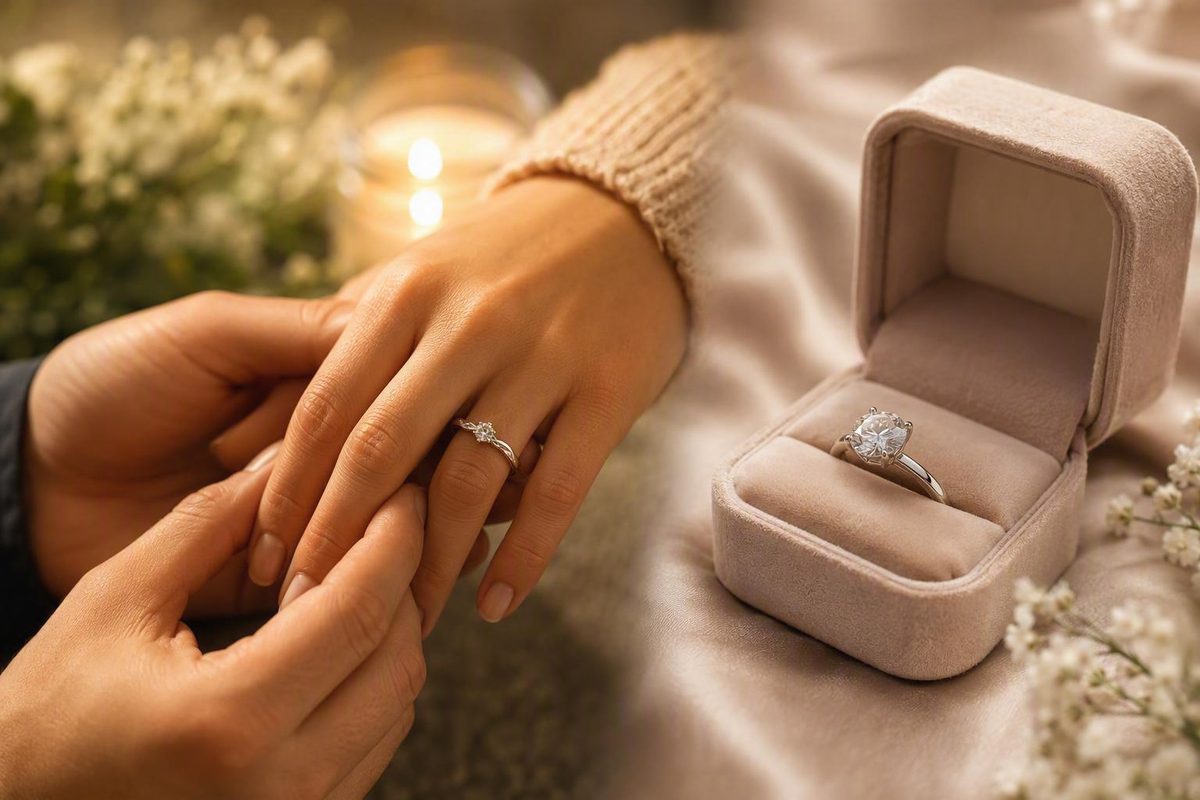
A promise ring expresses a commitment defined by the people involved without necessarily promising marriage; an engagement ring communicates a definite intention to marry. Appearance, price, presentation, and finger placement may shape assumptions, but the couple’s stated intent determines the meaning more reliably.
The difference in one sentence
The distinction is the promise’s specificity, not the relationship’s seriousness or the ring’s emotional importance. An engagement ring identifies a particular next step—marriage. A promise ring can represent exclusivity, fidelity, shared values, dedication during time apart, or another commitment chosen by the people involved.
A promise ring may come before an engagement, but it does not guarantee a proposal and does not have to lead to marriage. It can serve as a pre-engagement symbol, a temporary marker, or a sign of commitment without any intention to marry, as explained in the GIA guide to promise-ring meaning.
These terms describe social and symbolic meanings that can vary by couple, culture, community, and individual. This guide does not use them to address ownership or other legal consequences. To prevent misunderstandings about the relationship itself, the words used when exchanging the ring matter more than assumptions about what a ring “normally” means.
Promise ring vs. engagement ring at a glance
| Point of comparison | Promise ring | Engagement ring |
|---|---|---|
| Core meaning | A commitment defined by the people involved | A definite intention to marry |
| Connection to marriage | May refer to possible future marriage but does not inherently promise it | Specifically communicates that marriage is intended |
| Typical timing | Can be given at many stages of a relationship or personal journey | Usually associated with a proposal or an understood step toward marriage |
| Social expectations | Flexible; the meaning may need to be explained | More readily interpreted as indicating an engagement |
| Presentation | Often exchanged privately, although it may be presented publicly | Often treated as a public marker, although the proposal and engagement may remain private |
| Common design tendencies | Often simpler, with symbolic motifs, engraving, a small gemstone, or a plain band | More often designed around a prominent center gemstone |
| Finger placement | May be worn on any finger or on a necklace | Commonly worn on the left ring finger in some Western contexts |
| Budget | Often less costly | Often more costly, but no price or spending level defines either type |
These are broad conventions found in jewelry guidance, not universal rules or independent market measurements. A couple can exchange promise rings publicly, become engaged privately, choose a plain engagement band, or select a diamond promise ring.
There is also no universal promise-ring finger. A promise ring may be worn on any finger or on a chain around the neck, while the left ring finger is a common engagement-ring convention in some Western traditions—not a requirement everywhere. The GIA’s guidance on promise-ring styles and placement likewise presents these choices as flexible rather than mandatory.
Cost is similarly inconclusive. Materials, gemstone characteristics, band construction, and design complexity can affect price, but retailer estimates vary too widely to establish a useful universal benchmark. A ring’s price may reflect what it is made from and how it was produced; it cannot establish what the giver intends to promise.
What can a promise ring actually promise?
A promise ring does not inherently mean that marriage is planned. Depending on the people and circumstances, it can symbolize:
- Romantic exclusivity
- Fidelity
- Dedication during a long-distance relationship
- Shared values or goals
- Faith or a religious commitment
- Friendship
- Self-commitment
- A personal milestone
- Support through a particular period
- A possible future engagement
Pre-engagement is therefore one possible meaning, not the default. One couple might use a promise ring to say, “We hope to marry eventually.” Another might use a similar ring to mark exclusivity without agreeing to marriage or setting a timeline. Promise rings can also be exchanged between friends or purchased for oneself to represent a personal pledge or achievement; Whiteflash describes this range of possible meanings.
Because there is no standardized promise, the people involved need to define what the ring represents. Giving or accepting one should not silently establish a schedule for engagement, cohabitation, marriage, or any other relationship step. If one person interprets it as “nearly engaged” while the other sees it only as a symbol of present-day exclusivity, the ring can magnify the misunderstanding.
Agree on the commitment before attaching it to jewelry. The presentation may still be a surprise; the underlying relationship expectations should not be.
Which ring fits your relationship right now?
Start with one question: Are you communicating a definite, mutually understood intention to marry?
Choose an engagement ring when:
- The ring accompanies a marriage proposal.
- You have mutually discussed marriage, and the ring marks that agreed next step.
- You intend the recipient and other people to understand that you are engaged.
Consider a promise ring when:
- The commitment is important but broader than marriage.
- Marriage is a possible future outcome rather than an agreed next step.
- You want to mark exclusivity, fidelity, shared values, time apart, or another milestone.
- You want a symbolic ring without establishing an engagement.
Here is how that decision works in practice:
-
A couple is about to live in different cities for a year. They exchange rings to symbolize fidelity and continued effort while apart. Those are promise rings unless the exchange also establishes a definite intention to marry.
-
A couple can imagine marrying someday but is not becoming engaged now. A promise ring can recognize the relationship’s seriousness while leaving the marriage decision and timing open.
-
One partner asks the other to marry them, and the ring represents that proposal. It is an engagement ring—even if it is a plain band, inexpensive, or presented in private.
Do not use a promise ring to sidestep an unresolved disagreement about marriage. If one partner wants an engagement and the other does not, a less specific symbol may create false reassurance or pressure. Discuss whether marriage is desired, whether it has been agreed upon, and what the ring changes—if anything.
Neither ring is a mandatory relationship stage. A couple can move directly to engagement, commit without rings, exchange promise rings without later marrying, or marry without using an engagement ring.
Style and budget do not determine the answer
Promise rings and engagement rings can look alike. Either may use diamonds, colored gemstones, plain metal, engravings, or varied metals and settings.
A heart, engraved band, diamond or solitaire setting can represent either commitment. Choose the wearer’s preferred style and explain its meaning.
Set the budget according to:
- What you can comfortably afford without undermining other priorities
- How often the ring will be worn
- The durability required for the wearer’s routine
- The wearer’s preferred metal, stone, and style
- Whether resizing, maintenance, or future stacking matters
- Your shared financial priorities
Ignore salary formulas and arbitrary minimums. Spending more does not make a promise more sincere, and spending less does not prevent a ring from representing an engagement.
How to give a promise ring without implying a proposal
Do not rely on the box, setting, or occasion to communicate the promise. Discuss the relationship first, then use direct wording when giving the ring. If marriage is not being proposed, avoid phrases such as “Will you spend the rest of your life with me?” or other language likely to make the recipient believe an engagement is happening.
A clear presentation has three parts:
- Name the commitment.
- Explain what the ring represents.
- State what it does not mean if confusion is possible.
For exclusivity:
“This ring represents our commitment to being exclusive; it is not a marriage proposal.”
For long distance:
“I want this to symbolize that we are committed while we live apart.”
For possible future marriage:
“I can see us marrying someday, but this is a promise to keep building our relationship, not an engagement.”
Placement can reinforce that message. Wearing the ring on another finger or on a necklace may reduce the chance that other people interpret it as an engagement ring, particularly if its design resembles a conventional engagement style. Wording remains more reliable than placement because finger customs differ.
What happens to a promise ring after an engagement?
A promise ring does not automatically become an engagement ring when a proposal happens. It retains its original meaning unless the people involved explicitly agree to give it a new role.
After an engagement, the wearer can:
- Move it to another finger or hand
- Wear it on a necklace
- Stack it with other jewelry
- Keep it as a sentimental memento
- Incorporate it into a coordinated wedding set
- Repurpose or redesign it
- Continue wearing it as a symbol of the original promise
If you want the same ring to become the engagement ring, discuss that change directly. Its new meaning should come from shared agreement, not from assuming that the earlier promise has automatically advanced to marriage.
Think about future wear before buying if reuse matters. If the goal is to incorporate the promise ring into a later set, consider its proportions, metal, profile, and how it will sit beside another band.
Is there a required waiting period between a promise ring and an engagement ring?
No customary waiting period is required. A couple may become engaged soon afterward, wait years, or never pursue marriage; retailer etiquette guidance likewise states that there is no set interval between a promise ring and an engagement. Timing should follow mutual readiness and a clear agreement about marriage rather than an etiquette countdown attached to the earlier ring.