
Interlocking Wedding Bands: Fit Guide
Learn what locking, nesting, bridged and soldered designs mean, then check clearance, comfort, separate wear, resizing and price inclusions.
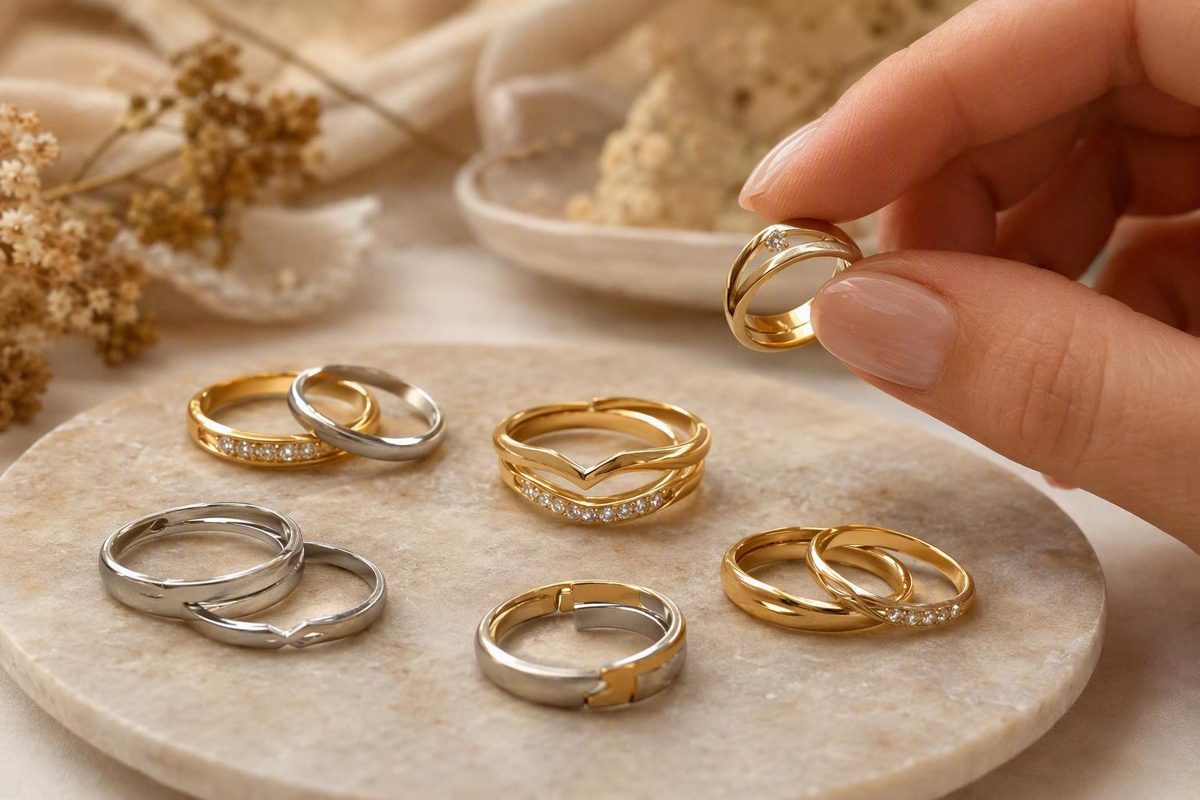
Interlocking wedding bands do not necessarily lock together. In the reviewed listings, “interlocking” can describe puzzle-like rings that assemble, contoured bands that nest beside an engagement ring, guards that frame it, or separate pieces that complete a coordinated design.
Choose according to the physical relationship between the rings—not the product name. Then test the exact pieces for clearance, comfort, movement, separate wear, and future serviceability.
What “interlocking” means in a ring listing
Start by separating two different shopping tasks:
- Puzzle-style rings: Two or more bands fit together, intertwine, or complete a motif when joined.
- An engagement-ring pairing: A wedding band, guard, wrap, jacket, or enhancer is shaped to sit beside or around an engagement ring.
The label alone does not reveal the connection method. Krikawa, for example, describes interlocking puzzle rings as two or more bands that fit together. Joseph Jewelry uses “interlocking” for a contoured wedding band designed to align with one specific engagement ring. One describes multiple bands completing a design; the other describes matched contours.
Classify the design by what the metal actually does
- Mechanically assembled: Multiple pieces physically fit together or intertwine.
- Contour-nested: One band follows the outline of another without necessarily locking.
- Enclosing or bridged: A guard frames the engagement ring; its outer bands may be connected.
- Visually coordinated: Separate pieces align to complete a pattern or silhouette.
- Permanently soldered: Previously separate rings have been joined into one assembly.
Before ordering, ask: Do the pieces lock, nest, frame, connect through bars, or merely align visually? Also ask whether they can be separated by hand, by removing them normally from the finger, or only through work performed by a jeweler.
Construction guide: nested bands, guards, enhancers, puzzle rings, and soldered stacks
Retailers often overlap terms such as guard, wrap, jacket, and enhancer. Do not rely on those labels as universal definitions. Count the physical pieces and establish how they fit together.
| Construction | How the pieces relate | Separate wear generally possible? | Main detail to verify |
|---|---|---|---|
| Contoured or nesting band | A curved edge follows the engagement ring | Usually | Whether the contour fits your exact setting |
| Two mirrored bands | Independent bands frame both sides | Often | Fit and appearance of each band alone |
| Wrap, jacket, or enhancer | One piece partially surrounds or frames the ring | Sometimes | Opening, clearance, and insertion method |
| Bridged or insert guard | Two outer bands are joined by small bars | Guard remains connected | How the engagement ring enters and exits |
| Puzzle-style rings | Two or more bands assemble or complete a design | Design-dependent | Whether they physically lock or only align |
| Soldered stack | Separate rings are permanently joined | No, unless separated professionally | Resizing, repair, separation, and warranty effects |
A contoured or nesting band follows the engagement ring’s outline. It may curve around a center setting, side stones, or projecting basket. Close nesting does not establish that the rings lock; they may simply sit closely beside each other.
A wrap, jacket, guard, or enhancer frames or partially surrounds an engagement ring. Some enhancers have a chevron-shaped opening that receives the engagement-ring setting.
A bridged or insert guard has two outer bands joined by small bars, leaving space for the engagement ring between them. Two mirrored contoured bands are different: they remain independent and can be placed separately. Serendipity Diamonds illustrates the distinction in its guide to bridged guards and separate contoured bands.
Puzzle-style interlocking rings contain multiple bands intended to fit together or complete a motif. Depending on the design, the pieces may physically intertwine or create the complete image only when aligned. Ask for a demonstration rather than assuming that “puzzle” means the pieces lock securely.
Finally, soldering is a permanent alteration rather than a removable interlocking mechanism. The engagement ring and wedding band become one assembly, so they no longer move or function as independent rings.
Start with the engagement ring’s side profile
Compatibility depends on the geometry of both rings, not finger size alone. Rings in the same nominal size can still interfere with each other if a basket, bridge, side stone, shoulder, or decorative edge occupies the space where the companion band needs to sit.
Inspect the engagement ring from the side under bright, even light. Identify:
- the basket or other structure beneath the center stone;
- the bridge and any metal extending toward the finger;
- prongs that project sideways;
- cathedral shoulders rising toward the center;
- side stones and their settings;
- the width and thickness of the shank;
- raised engraving, milgrain, pavé, or sharp decorative edges.
Then inspect the corresponding surfaces of the prospective wedding band. A straight band may work where the engagement-ring setting leaves adequate clearance. If the profile obstructs that path, a curved, chevron, wrap, or custom-contoured design may fit more practically. Retailer fitting guidance specifically identifies the side profile, supporting metal, width, thickness, raised settings, and decorative edges as relevant compatibility factors.
Do not rely too heavily on broad labels such as “high profile” or “low profile.” Examine the actual basket, bridge, shoulders, and side stones. A center stone can appear elevated while supporting metal lower in the setting still obstructs a straight band.
A purpose-designed companion band is evidence of intended alignment only with the specified engagement ring. Joseph Jewelry’s documented example was contoured around one companion setting, with two accent diamonds positioned in gaps created by that setting’s wrapped shank. It does not establish compatibility with a visually similar ring.
If the engagement ring is still being designed and exact alignment matters, plan the wedding band at the same time. The reviewed custom-jewelry materials describe CAD images and physical models as possible approval stages, allowing the buyer to assess proportions and shape before production.
The in-person fit test: inspect the whole stack
A photograph can show the intended silhouette, but it cannot establish how the set feels on your finger. Try the exact engagement ring and exact companion pieces together—not another sample in the same nominal size.
- Assemble the complete set. Put the rings on in the intended order and confirm that every component seats normally.
- Inspect from above. Look for rotation, uneven spacing, displaced curves, or one side sitting higher than the other.
- Inspect from the side. Check how the basket, bridge, prongs, stones, and band edges meet.
- Inspect the palm-facing side. Look for bulky connectors, abrupt edges, crossed bands, or pressure points.
- Move your hand normally. Open and close your hand, make a relaxed fist, and handle lightweight objects available during the fitting.
- Wear the stack long enough to assess comfort. A wider combined stack can feel tighter than either ring does separately.
- Test every removable component alone. Check whether it rotates, catches, feels awkward, or appears unfinished without the other pieces.
Retailer fit guidance advises checking the actual rings together for rotation, pinching, catching, excessive tightness, and repeated rubbing; it also notes that stacked rings can feel tighter together than they do separately. Treat those observations as reasons to pause and request a jeweler’s assessment—not as proof that damage has occurred. See the cited ring-stacking fit guidance.
A flush fit is optional. A deliberate gap may accommodate the setting or provide visual separation. Functional clearance and comfort matter more than forcing the rings into contact to create an uninterrupted outline.
Before the return window or custom-production approval expires, photograph the accepted arrangement from above, both sides, and the palm-facing view. Photograph each removable component separately as well. This creates a practical record of the approved configuration and orientation, not a guarantee of future performance.
Choose between separable pieces, a joined guard, and soldering
The appropriate structure depends on whether you value flexible wear, fixed alignment, or permanent joining.
| Option | Principal advantage | Main tradeoff | Verify before proceeding |
|---|---|---|---|
| Separate contoured bands | Flexible arrangement and independent wear | Pieces may rotate or feel different alone | Movement, contact, and comfort in every configuration |
| Bridged or insert guard | Framing bands remain aligned as one component | Less independent flexibility | Insertion, removal, connector access, and center-ring fit |
| Soldering | Rings become one assembly | Independent wear ends | Resizing, separation, repair access, and warranty effects |
With separate contoured bands, you can rearrange the stack, remove the engagement ring, or wear an individual band. That flexibility is useful only if each piece works by itself, so test every configuration you expect to wear.
With a bridged or insert guard, the framing bands remain connected while the engagement ring occupies the center opening. Ask the jeweler to demonstrate insertion and removal. Confirm whether the center ring can be removed without bending, cutting, or altering the guard.
With soldering, the rings become one assembly and stop moving independently. The tradeoff is reduced flexibility: separate wear ends, and later resizing or separation can become more complicated. Commercial jeweler guidance therefore recommends professional assessment before altering, joining, or separating a set; it does not establish soldering as universally preferable. See the explanation of soldering and separable alternatives.
Plan for resizing, repairs, cleaning, and warranty restrictions
Ask the jeweler to show how its interior surfaces, connectors, settings, and stones can be reached for inspection, cleaning, and repair.
Do not treat resizing as a simple question of whether metal can be added or removed. Ask how changing either ring could affect:
- contour alignment;
- symmetry between framing bands;
- connector position;
- accent-stone spacing;
- insertion and removal of the engagement ring;
- engraving or patterned sections;
- the fit of the complete stack.
Also ask what happens if a companion piece is lost or damaged. Can the seller reproduce it? Will measurements, CAD files, models, or approved images be retained? Obtain the answer in writing rather than assuming a custom design can be recreated years later.
Warranty coverage is seller-specific. Ring Concierge’s policy, reviewed September 20, 2026, excludes matters including normal wear, accidental damage, improper care, gradual wear to prongs and metal components, and third-party work. It also states that outside resizing or repair voids that retailer’s warranty. Those terms apply to Ring Concierge purchases, not jewelry generally, and should be reconfirmed before relying on them. Read the current Ring Concierge warranty terms.
Before resizing, soldering, polishing, engraving, or authorizing an outside repair, obtain the applicable terms in writing. Confirm return eligibility, remake rights, service charges, shipping responsibility, and whether third-party work changes coverage.
What prices include—and what they may leave out
The reviewed examples cannot establish a market-wide price range. They cover different products: a single custom wedding band, bridal settings, partner sets, diamond-set enhancers, and complex designer pieces. The number of rings, materials, stone content, customization, and center-stone inclusion vary.
The following seller prices were checked September 20, 2026:
- Joseph Jewelry listed a single custom contoured wedding band—explicitly identified as “wedding band only”—at $1,449 on its product page.
- Barkev’s displayed selected interlocking bridal-set starting prices from $1,450 to $3,515. Its purchase flow says “Select Setting,” “Add Diamond,” and “Complete Ring,” so the buyer should verify whether the center diamond requires a separate purchase on the Barkev’s collection page.
- Bliss Lau displayed products priced from $2,200 to $12,200, with several listings marked “from,” in its interlocking wedding-band collection.
These are seller-specific snapshots, not averages, and prices may change. They should not be compared as though they purchase the same number of rings, quantity of metal, stone content, or level of custom work.
For each quote, confirm whether it includes:
- one wedding band;
- two puzzle or partner bands;
- two separate framing bands;
- a joined guard or enhancer;
- the engagement-ring setting;
- accent diamonds or gemstones;
- the center diamond;
- taxes, shipping, and alterations.
If the ordering process begins with a setting, verify whether the center stone must be selected and paid for separately. Ask how metal, finger size, custom contouring, engraving, stones, CAD work, models, and post-production alterations are handled in the final quote.
A jeweler checklist before you order
Copy this list into an email and request written answers:
- [ ] What does “interlocking” mean for this design: locking, nesting, framing, bridging, or visual alignment?
- [ ] How many physical pieces are included?
- [ ] Is the band made for my exact engagement-ring model?
- [ ] Can I try the complete set using my actual engagement ring?
- [ ] Where do the pieces touch?
- [ ] Are any prongs, stones, edges, finishes, or engraved surfaces in repeated contact?
- [ ] Can every removable piece be worn independently?
- [ ] How does each piece fit, rotate, and look when worn alone?
- [ ] Are any components permanently fused?
- [ ] Is soldering necessary, optional, or not recommended for this construction?
- [ ] How is the engagement ring inserted into and removed from a joined guard?
- [ ] How could resizing affect contour alignment, connectors, symmetry, or stone placement?
- [ ] Could separation, repair, polishing, engraving, or outside work affect the warranty?
- [ ] Can enclosed surfaces, stones, bars, and contact areas be reached for cleaning and repair?
- [ ] What exactly does the quoted price include?
- [ ] Is the center stone included or purchased separately?
- [ ] Are custom or engraved orders returnable, resizable, or eligible for a remake?
- [ ] Which approvals occur before production—drawings, CAD images, models, or final measurements?
- [ ] What records, dimensions, CAD files, or models will be retained for future service?
- [ ] Can a lost or damaged companion band be reproduced, and under what terms?
Choose by construction, not by the word “interlocking.” Identify how the pieces relate, test the complete set with the actual engagement ring, and document the price inclusions, alteration limits, service options, and warranty consequences.
Can interlocking wedding bands be worn separately?
Sometimes. A bridged guard remains one connected component. A soldered stack cannot be worn separately unless a jeweler separates it.
Does a wedding band need to sit flush with an engagement ring?
No. A visible or intentional gap is not automatically a defect. Comfort, stability, and workable clearance around the setting, prongs, stones, and edges matter more than achieving a perfectly continuous outline.
Can an interlocking band fit an engagement ring from another seller?
Possibly, but do not assume it will. Compatibility depends on the exact basket, bridge, prongs, side stones, shoulders, width, thickness, and decorative edges—not merely ring size or center-stone shape. A band designed for a named companion ring demonstrates intended alignment with that model only. Try the exact pieces together or have a jeweler measure the existing ring for a custom contour.