
Stacked Eternity Bands: Choose by Fit & Coverage
Check full, three-quarter and half options against side-profile contact, complete-stack fit, comfort and resizing limits.
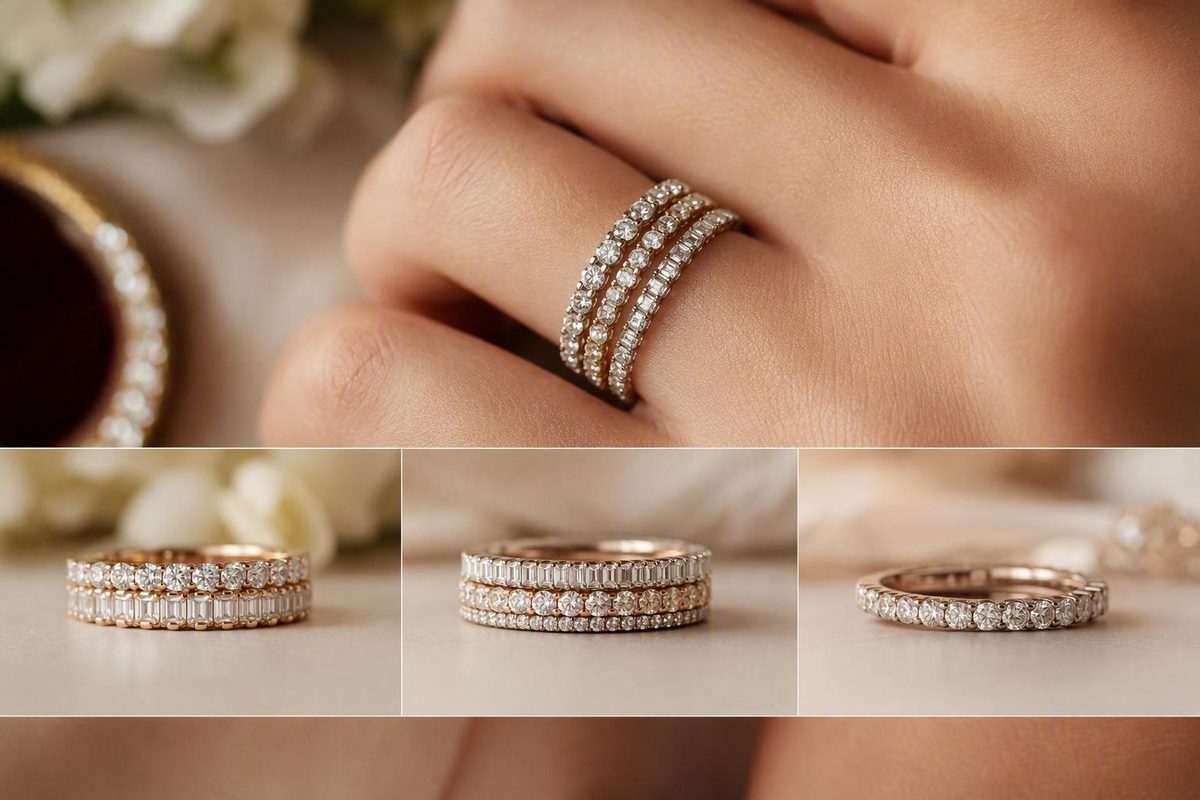
The best stacked eternity bands are chosen from the side profile outward—not by a fixed ring count or the most dramatic top-down photograph. First confirm that the bands clear the engagement-ring setting without harmful contact. Then test the complete stack for fit. Only after those checks should you choose full, three-quarter, or half coverage according to rotation, resizing needs, comfort, and budget.
The quick choice: full, three-quarter, or half eternity?
| Factor | Full eternity | Three-quarter eternity | Half eternity |
|---|---|---|---|
| Visible stone coverage | Continuous around the ring | Nearly continuous, with a plain section | Concentrated across the visible upper portion |
| Rotation risk | Rotation does not expose plain metal | Plain metal may appear if the ring rotates | Plain metal may appear more readily if the ring rotates |
| Palm-side exposure | Stones and settings remain beneath the palm | Some stones may extend toward the underside | Usually has the largest plain-metal underside |
| Cost and resizing | Generally costs more; conventional resizing is often difficult | May fall between full and half in comparable designs; resizing can remain limited | Generally costs less in comparable designs; may offer more resizing flexibility |
Stacked eternity bands are diamond- or gemstone-set bands worn together or alongside engagement, wedding, anniversary, or fashion rings. The word “eternity” is not precise enough by itself: it may describe stones around the entire circumference or only part of the band.
A full-eternity band has stones around the complete circumference. Partial designs leave some plain metal, but “half eternity” does not always mean exactly 50% coverage. Depending on the maker, stones may cover approximately one-third, one-half, two-thirds, or another proportion, so ask the seller to confirm the exact coverage in writing. These variable proportions and their implications for resizing are explained in this full-versus-half eternity-band guide.
Choose full eternity when uninterrupted coverage matters enough to justify the generally higher cost, greater exposure of stones and settings beneath the palm, and limited conventional resizing. It is particularly useful for someone whose rings rotate and who does not want that movement to reveal plain metal.
Choose partial eternity when a smoother underside, lower general cost, or more potential resizing flexibility matters more. The tradeoff is visual: if the ring rotates, its plain section may become visible. Correcting a loose fit can reduce spinning, but finger shape and knuckle size may still allow movement.
A three-quarter-eternity band is a middle option, not a guaranteed best-of-both-worlds answer. It provides more coverage than a half band while retaining some plain metal, but it can still rotate. Its unset section may also be too small for the requested resize.
Coverage alone does not establish comfort, durability, or resize feasibility. Width, setting depth, stone dimensions, decorative details, metal, fit, and the size change all matter. A partial band provides potential working room, not a promise that conventional resizing will be straightforward.
Match the band to the engagement ring before styling the stack
Start with the engagement ring’s profile:
- Raised setting with open space beneath the center stone: try a straight eternity band.
- Low or wide setting: investigate a curved, contoured, notched, or shadow band.
- Halo, east-west stone, or unusual outline: test shaped bands or an intentionally spaced arrangement.
- No shaped band sits cleanly: consider deliberate negative space rather than forcing the rings together.
A visible gap is not automatically a defect. Negative space can keep a complex center setting from looking crowded. It works when the rings remain stable, feel comfortable, and do not collide at vulnerable points.
Inspect every proposed stack from the side, not only from above.
Check for contact involving:
- exposed diamond or gemstone girdles;
- raised or shared prongs;
- sharp setting edges;
- the engagement-ring basket;
- stone-to-stone contact;
- stone-to-metal contact;
- metal rubbing directly against prongs or a setting wall.
Adjacent rings can scratch metal or gradually wear settings. The outcome depends on each ring’s profile, fit, movement, alloy, and exact contact location rather than simply whether the metal colors match. GIA specifically notes that gold may wear more quickly when stacked against harder platinum under some contact conditions; its ring-stacking guidance recommends professional assessment when rings rub, scratch, or cause discomfort.
That warning is not a blanket prohibition against mixed metals. A well-fitted mixed-metal stack without damaging contact may be more workable than two same-metal rings whose stones or settings grind against one another.
There is no supported universal clearance measurement that can replace seeing how the actual rings move together.
Test fit using the complete stack, not one ring at a time
Several rings occupy more width on the finger than one ring, so a stack can feel tighter even when every band seems correctly sized alone. That does not create a universal rule to size up. Finger shape, knuckle size, swelling, total width, interior profile, and personal fit preference all affect the result.
Use the following as a practical try-on checklist rather than a substitute for professional sizing:
- Put on every intended ring in the order you expect to wear it.
- Test the stack when your hands feel typical rather than unusually cold or swollen.
- Make a fist, then spread and bend your fingers.
- Move your hand as you normally would and check whether the rings interfere.
- Look for pinching, persistent pressure, overlap, or trapped skin.
- Note whether the rings spin independently or shift as one unit.
- Confirm that the complete stack passes over the knuckle without painful pressure.
- Wear it long enough to determine whether initial unfamiliarity develops into continuing discomfort.
With a partial-eternity band, watch whether rotation reveals the plain section.
Repeat the test in more than one order.
If you expect to add anniversary, milestone, or heirloom bands, do not fill every available millimeter immediately. Additional rings increase total width and may change how the existing bands sit. Plan visual space and finger space together.
Professional sizing of the full arrangement is sensible when the stack feels tight, spins excessively, or must pass over a much larger knuckle. Bring all intended rings to the appointment; sizing one ring in isolation can solve the wrong problem.
Choose width, setting, metal, and stones as a system
Current retailer collections show how widely eternity-band dimensions vary. Anna Sheffield lists examples in 2 mm and 3 mm widths, illustrating two options within the delicate-to-substantial range rather than establishing a universal ideal. See the retailer’s stacking-band collection.
Holden lists eternity-band widths of 1.5 mm, 2.5 mm, and 3.5 mm, providing additional reference points across that range. Width should be judged together with stone size, side-profile height, neighboring rings, and the available space on the finger—not as an isolated specification. Holden’s listed dimensions appear in its eternity-ring comparison.
Three useful starting formulas are:
- Minimalist: one narrow eternity band plus one plain band. Repeat the metal tone or finish and let the stones provide contrast.
- Bridal: wedding band closest to the hand, engagement ring in the middle, and eternity band above. Reverse the arrangement if another order fits better or prevents contact.
- Mixed: combine a colored-gemstone eternity band with a diamond ring, or use contrasting metal colors while repeating one tone elsewhere.
A cohesive stack does not require three matching rings. Repeat one element—metal tone, diamond shape, setting style, texture, or gemstone color—and allow the remaining details to differ. A yellow-gold plain band, for example, can connect visually with yellow-gold prongs on an otherwise white-metal engagement ring.
Treat setting names as descriptions of appearance and profile:
The available evidence does not establish any one of these as universally safest or most durable for stacking. Examine the exact construction.
Mixed metals can be an intentional design choice. Assess the actual alloys, profiles, fit, movement, and contact points rather than assuming that metal color predicts compatibility.
Ring order is personal as well. Traditional bridal order places the wedding band closest to the hand, but an eternity or anniversary band can sit above, below, or separately from the engagement ring when that arrangement fits comfortably and avoids damaging contact.
Match common stack problems to the right fix
Identify the problem before buying an accessory or altering the rings. A connector, adjuster, spacer, and solder joint perform different jobs.
| Problem | Likely issue | First response | Important limitation |
|---|---|---|---|
| Shape mismatch or unwanted gap | Straight band cannot clear the engagement-ring setting | Try a curved, contoured, notched, or shadow band | A stable intentional gap may be acceptable |
| Harmful rubbing | Stones, prongs, or settings touch | Reassess the profiles or test a thin spacer | A spacer adds width and another contact surface |
| Slight looseness | One ring is marginally loose | Consider a removable fit adjuster or sizing guard | It does not join separate rings |
| Incorrect sizing | Ring consistently spins, pinches, or fits poorly | Seek professional resizing | Feasibility depends on construction |
| Misalignment | Separate bands will not remain in position | Consider a removable connector | It must suit the band profiles and may affect comfort |
| Unwanted independent movement | Rings continually shift against one another | Discuss soldering after reversible options | The rings cannot be worn independently without later work |
A contour band addresses shape mismatch. A thin spacer instead separates vulnerable surfaces and can serve as a reversible experiment before permanent alteration. Test it with the complete stack because its added width can make a previously comfortable arrangement feel tight.
A removable connector wraps around separate bands to keep them aligned. An adjuster or sizing guard addresses slight looseness in a ring; it is not intended to join the stack. When the underlying ring size is wrong, professional resizing is the more lasting response if the construction permits it.
Soldering permanently joins rings and controls their movement relative to one another. It also removes the option to wear them independently and can complicate later resizing, repairs, or additions. These distinctions are outlined in Sylvie’s guide to connectors, adjusters, resizing, and soldering.
Have a jeweler inspect an eternity band before resizing or soldering it. The appropriate work depends on stone coverage, setting construction, metal, dimensions, and the amount of alteration required.
What to compare when shopping for stacked eternity bands
Do not compare eternity bands from photographs and headline prices alone. Ask for:
- exact circumference coverage;
- ring width and side-profile height;
- setting type;
- stone dimensions, count, and total carat weight;
- disclosed stone quality;
- metal and alloy;
- complete available size range;
- resizing, exchange, or remaking options;
- access to repair services;
- replacement-stone policy;
- warranty coverage and exclusions;
- return window;
- side-profile photographs or video.
The word “eternity” may not reveal whether stones cover the full circumference, half the band, or another proportion. Confirm the construction in writing, especially when the product page shows only a top view.
The following September 2026 snapshot illustrates variation among retailer-specific listings. It does not represent market averages or establish which ring offers the best value:
- Tiffany listed 2 mm platinum Soleste bands at $3,400 for half eternity and $5,600 for full eternity. Because the two products belong to one branded design family, the comparison illustrates how greater coverage can affect the listed price. See Tiffany’s stacking-ring listings.
- Audry Rose listed a 1.5 mm 14k-gold band with 44 natural round diamonds totaling 0.40 carats for $1,190. The captured specifications did not establish the exact circumference coverage, demonstrating why the product name alone is insufficient. Check the Audry Rose product specifications.
- Holden listed starting prices of $899 for half, $999 for three-quarter, and $1,199 for full eternity bands. This is one seller’s coverage ladder, not proof that three-quarter designs always occupy the middle price position across the wider market.
Recheck current price, inventory, specifications, return terms, and warranty language immediately before ordering. Normalize any comparison for ring size, width, metal, stone dimensions and quality, setting, and exact coverage—not merely the number beside the add-to-cart button.
Plan for resizing, repair, and routine wear before buying
Conventional resizing commonly involves cutting the shank, adding or removing metal, reconnecting it, and restoring the ring’s shape. A full-eternity band may have no plain section where that work can occur without disrupting the stone layout, which is why conventional resizing is often difficult.
That does not mean every full-eternity band is impossible to modify. Limited specialist alteration may sometimes be feasible, while exchange or remaking may produce a more practical result in other cases. Obtain a design-specific answer before purchase rather than relying on a general store policy.
A partial-eternity band may provide plain metal for resizing, but it is not automatically resizable. Stone coverage, decorative details, dimensions, metal, requested size change, and the setting’s ability to tolerate reshaping all matter.
For frequently worn stacks:
- use cleaning methods appropriate for the specific stones and settings;
- check periodically for loose stones or changes in the settings;
- store the rings separately when they are not being worn;
- remove the stack during activities likely to damage jewelry;
- monitor recurring contact points for visible wear.
Rubbing, loose stones, or persistent discomfort warrant professional assessment. Do not assume that movement or wear can be corrected simply by tightening, soldering, or adding an accessory without first identifying the cause.
Before the return period expires, obtain written answers about resizing, replacement stones, repair methods, ring-to-ring wear, and warranty coverage. Ask who performs or authorizes repairs, who remains responsible for the work, and whether outside servicing changes the warranty.
A final pre-purchase jeweler check should cover five points:
- Examine the complete stack on the finger.
- Identify every contact point from the side.
- Confirm fit with all intended rings together.
- Assess resizing and repair feasibility for each band.
- Discuss how future anniversary or milestone bands would change the arrangement.
Choose the stack from the side profile outward: eliminate harmful contact, confirm the complete fit, and then decide how much stone coverage and visual contrast you want. Full eternity can justify its generally higher cost when uninterrupted coverage is the priority; partial coverage may preserve more sizing and underside-comfort options. The exact rings—not their category names—determine whether the finished stack works.
Can an eternity band be worn alone instead of in a stack?
Yes. An eternity band can serve as a wedding, anniversary, milestone, or fashion ring without neighboring bands. A full-eternity design provides uninterrupted coverage when the ring rotates, while a partial design can still present a stone-set face from above. Apply the same fit, resizing, and maintenance checks even when the ring will be worn alone.
Is there an ideal number of eternity bands to stack?
No. There is no supported ring count that suits every finger or design. The practical limit depends on total width, finger length, knuckle size, setting profiles, movement, and comfort. Two substantial bands may occupy more usable space than several narrow ones. Add bands only while the complete arrangement remains comfortable, stable, and free from damaging contact.