
VS2 Diamond Clarity: Meaning, Eye-Clean Checks and Value
Learn what VS2 diamond clarity means, how to verify an eye-clean claim, and when comparing VS1 or SI1 makes more sense for the stone you want to buy.
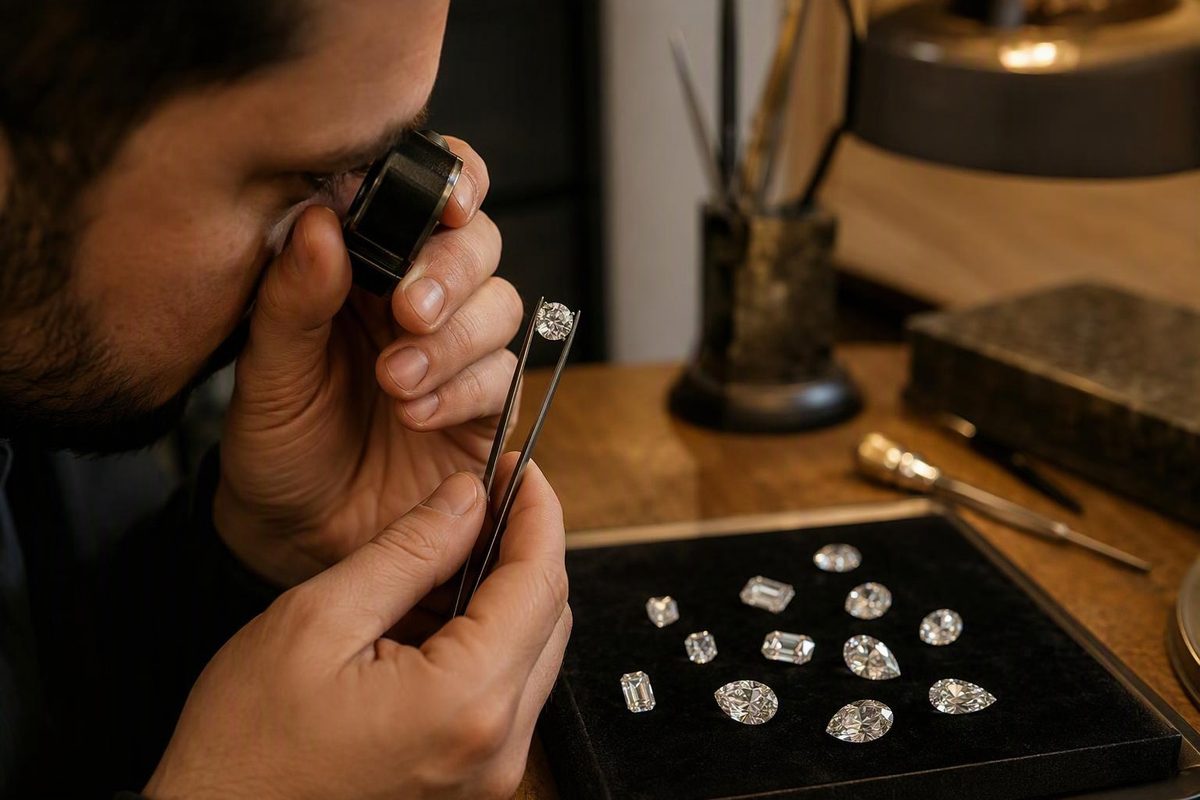
VS2 diamond clarity means Very Slightly Included 2: minor inclusions that a trained grader can see somewhat easily at 10× magnification. It is a sensible buying target when the individual diamond looks clean to you and compares well on price, but VS2 does not guarantee an eye-clean stone. GIA’s clarity guide explains the grading conditions and distinguishes eye-clean appearance from a laboratory grade.
Select what you have verified about your VS2 diamond; the tool identifies your next buying step.
VS2 Buying Check
Verify Appearance First
Inspect this exact diamond without magnification in diffuse daylight and ordinary indoor light. An enlarged video alone does not establish eye-clean appearance.
This check sets your next step; it does not grade the diamond or certify durability. A buying decision still needs comparable prices and acceptable return terms.
Source: GIA clarity, quality-factor and report guides cited in the article; no price estimates used.
VS2 Sits Between VS1 and SI1
On the GIA clarity scale, VS2 sits one grade below VS1 and one above SI1. The “2” identifies the lower of the two VS grades; it does not mean the diamond has two inclusions. GIA describes VS1 inclusions as difficult to see at 10×, VS2 inclusions as somewhat easy to see, and SI1 inclusions as easy to see. Those descriptions concern trained graders using magnification, not what a buyer will necessarily notice unaided.
A VS2 grade does not specify one inclusion pattern. Graders consider the characteristics’ size, number, location, nature and contrast against the diamond. A small, dark inclusion under the central table—the large top facet—presents a different buying question from several low-contrast inclusions toward the edge.
For the full scale, see our diamond clarity scale chart.
Eye-Clean VS2 Must Be Verified Stone by Stone
A VS2 diamond can be eye-clean. The term describes a diamond whose inclusions cannot be seen with the unaided eye; it is not a GIA grade. A seller’s eye-clean claim needs inspection conditions attached to it, not just a reassuring label.
Ask whether the exact diamond was checked face-up only or from the side as well, at what viewing distance, and under what lighting. A statement about VS2 diamonds generally does not establish the appearance of the stone you are buying.
Start your own inspection without magnification, at a comfortable viewing distance, in diffuse daylight and ordinary indoor light. Tilt and rotate the diamond. Use magnification afterward to locate the inclusions, then check whether you can still notice them without it. This separates characteristics visible only in an enlarged view from those that affect your everyday enjoyment of the stone.
An enlarged sales video helps locate inclusions, but it is not a normal-size eye-clean test. When buying remotely, request a view at approximately life size and written confirmation of the seller’s inspection conditions. The return policy should allow you to inspect the diamond yourself.
Emerald and Asscher Cuts Need Close Central Inspection
Inclusions are typically easier to see in emerald cuts than in round brilliants because the emerald cut’s long facets expose them more readily. Brilliant-cut facets can make inclusions less apparent, although reflections can also repeat a visible inclusion. GIA explains how cutting style affects inclusion visibility.
For an emerald or Asscher-cut diamond, scrutinize the central view before accepting VS2. For a larger stone, prioritize normal-size inspection rather than assuming a carat-weight cutoff guarantees a clean appearance. Shape and size guide where to look; neither replaces looking at the actual diamond.
VS1, SI1 and VVS Offer Different Trade-Offs
| Comparison | Grading Difference | Buying Judgment |
|---|---|---|
| VS1 vs. VS2 | VS1 inclusions are harder to see at 10×. | Compare VS1 if the VS2 has a visible inclusion or you prefer less apparent characteristics under magnification. |
| VS2 vs. SI1 | SI1 inclusions are easier to see at 10×. | Consider SI1 only after checking its appearance and inclusion characteristics. |
| VS2 vs. VVS | VVS inclusions are much harder to see at 10×. | If both look equally clean to you, the higher grade may buy rarity rather than a visible improvement. |
All else equal, higher clarity increases price per carat, but that does not establish a fixed VS2 discount. GIA links clarity pricing to rarity. No price benchmark or percentage saving is supplied here; compare actual asking prices for diamonds of the same origin, similar weight, shape, color, cut quality and grading laboratory.
Do not sacrifice attractive light performance merely to reach VS1 or VVS. Clarity describes inclusions and blemishes; cut governs how the diamond interacts with light. GIA’s quality-factor guide explains the distinction.
A higher clarity grade is worth considering when it resolves something you can see or satisfies a preference you knowingly want to pay for. If two diamonds look equally clean to you, the grade alone does not establish that the higher-clarity one will look better.
Read the Report Beyond the VS2 Grade
Read the clarity characteristics, plotting diagram if supplied, and comments. A sparse plot is not proof that few inclusions exist: some faint or widespread characteristics may appear in comments instead. A report without a plot is not necessarily deficient; GIA’s Diamond Dossier uses the same clarity-grading criteria without one. GIA explains plotting diagrams and their limits.
A listed feather is not an automatic rejection. Ask a qualified gemologist to assess any questionable surface-reaching feature, particularly near the setting edge. GIA notes that some surface-reaching inclusions can increase vulnerability to damage. Durability concerns that affect the clarity grade are rare and usually apply to Included-grade diamonds, as explained in GIA’s quality-factor guide.
Verify a GIA report through GIA Report Check, which confirms that its information matches the laboratory database. That verifies the report data; it does not replace matching the physical diamond to the report.
Lab-Grown VS2 Labels Need a Clear Report Source
For lab-grown listings, check the issuing laboratory and report date. GIA changed its D-to-Z lab-grown service to overall Premium/Standard assessments from October 1, 2025, rather than individual natural-diamond color and clarity grades. That change concerns GIA’s specified lab-grown service, not every laboratory or natural-diamond report.
A seller’s VS2 label should identify its supporting report or assessment source. GIA’s service announcement explains the change. See our guide to GIA lab-grown diamond reports for more detail.
Buy VS2 when the specific diamond looks clean to you, its inclusion characteristics are acceptable, and its price compares well. Move higher for an observable benefit or a personal preference—not because VS2 is inherently inadequate.