
Men’s Black Diamond Studs: How to Compare
Check whether a listing is for one stud or a pair, then compare stone count, weight basis, millimeter size, color origin, setting and reports.
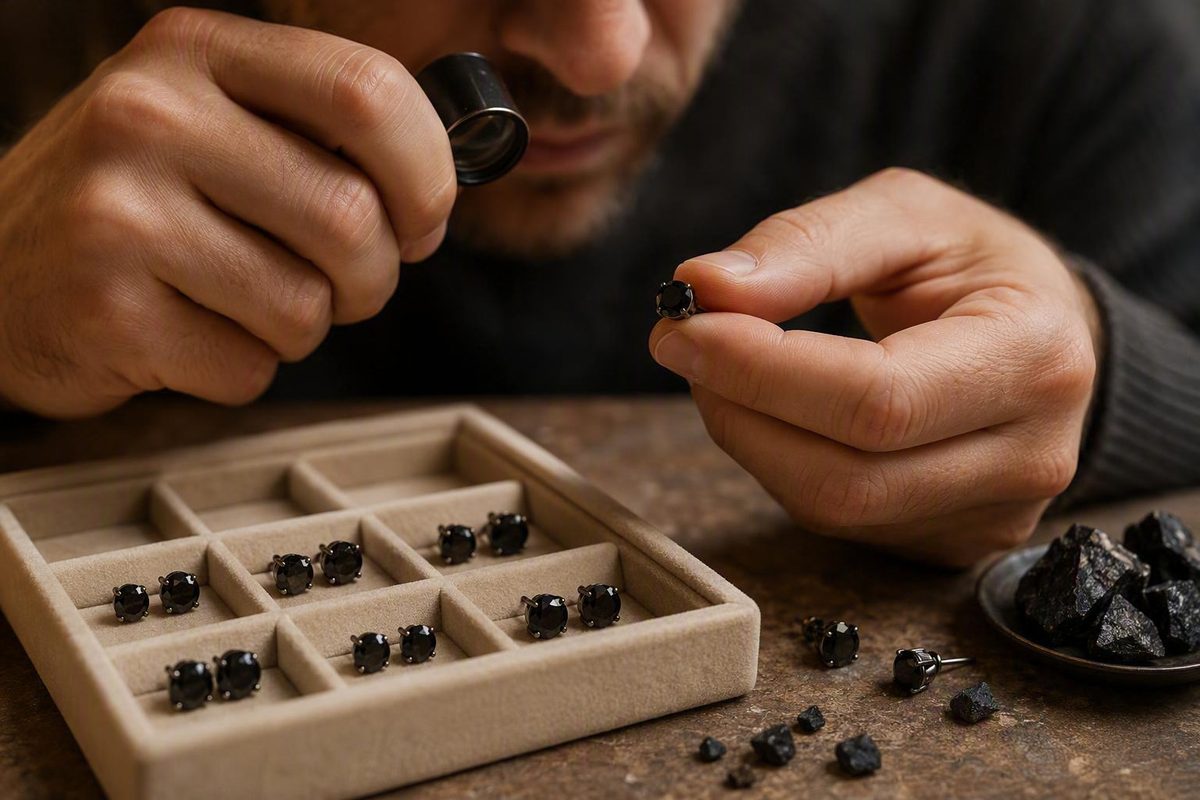
The safest way to compare men’s black diamond studs is to ignore the headline price and carat figure until you know what is being sold. Confirm whether the listing is for one stud or a pair, how many stones it contains, whether the weight is per stone or combined, its millimeter dimensions, the diamond’s identity and color origin, the setting, backing, metal, documentation, and return terms. “Natural diamond” alone does not prove that the black color is natural.
The 60-second buying checklist
Before paying, verify:
- Quantity: one stud or a pair.
- Stone count: one solitaire per ear, a cluster, or a design with accent diamonds.
- Weight basis: per stone, per earring, or total carat weight for the pair.
- Dimensions: the principal stone’s measurements and the complete earring width in millimeters.
- Diamond identity: natural diamond, laboratory-grown diamond, or a simulant.
- Color origin: naturally black or treated to appear black.
- Documentation: laboratory name, report type, and report number.
- Setting: bezel, semi-bezel, prong, flush, cluster, or another construction.
- Backing: friction, screw, locking, or another mechanism.
- Metal: both the visible setting and the post and back.
- After-sale terms: returns, warranty, repairs, replacement backs, and single-earring replacement.
- Plating: whether an all-dark setting uses black rhodium and what refinishing service is available.
Diamond identity and color origin are separate questions. A natural diamond may have naturally occurring black color, or it may have been treated after mining. Ask both, rather than accepting “natural” as a complete disclosure.
Do not compare headline prices until the products are on the same basis. A single solitaire, a solitaire pair, and a 50-stone cluster are fundamentally different products even if their titles contain similar carat figures. Metal purity, documentation, treatment disclosure, brand, and setting complexity can widen the price difference further.
A practical default is to choose scale by millimeter appearance rather than by a gender-based size rule. Favor a protective setting if the earring will regularly meet headphones, collars, towels, or sports gear. Select the backing according to the balance you want between security and comfort. Most importantly, do not pay a premium for claimed natural black color without verifiable documentation.
Decode carat weight, stone count, and visual size
Carat measures mass, not diameter. It does not tell you the complete width of the earring, how much metal surrounds the stone, or whether the weight is concentrated in one diamond or spread across dozens of small diamonds. When visual presence matters, request millimeter measurements alongside the carat figure.
“Ctw,” “ct. tw.,” and similar abbreviations generally refer to combined total carat weight. If a matched pair contains two evenly weighted solitaire diamonds totaling 3.00 ctw, the approximate weight is 1.50 ct per ear. Do not make that division for clusters, halos, asymmetrical earrings, or designs whose stated weight includes accents unless the seller provides a breakdown.
Listings generally fall into four formats:
- Single solitaire: one earring containing one principal diamond.
- Solitaire pair: two earrings, usually with one principal diamond in each.
- Multi-stone cluster pair: numerous small diamonds create each earring’s outline.
- Center-and-accent design: the stated total may combine the principal black diamonds with surrounding stones.
A worked comparison shows why those distinctions matter. David Yurman lists one sterling-silver stud measuring 7 mm with a stated 1.10 ct black diamond. Helzberg lists a pair measuring 9.40 mm wide and containing 50 diamonds totaling approximately 0.25 ctw. The wider Helzberg earring is not a larger solitaire; its width comes from the complete cluster design. These specifications come from the David Yurman single-stud listing and the Helzberg cluster-pair listing.
Before buying, ask the seller to state:
- The number of earrings and stones
- The weight of each principal stone
- The total stated weight for the pair
- Whether accent stones are included in that weight
- The principal stone’s dimensions
- The complete earring’s width, depth, and profile
- For a cluster, whether a per-ear weight breakdown is available
These details reveal more about actual scale than the headline carat number alone.
Natural-color, treated, lab-grown, or simulated: what the label means
Black stones sold in diamond-stud designs can belong to four different categories:
| Category | What it means | What to verify |
|---|---|---|
| Natural-color black diamond | Earth-formed diamond with naturally occurring dark appearance | Diamond identity and natural color origin |
| Treated natural diamond | Earth-formed diamond treated to produce or intensify a black appearance | Treatment disclosure and report wording |
| Laboratory-grown black diamond | Diamond grown through a manufacturing process | Explicit laboratory-grown identification |
| Simulant | A different material resembling black diamond | Exact material, such as moissanite, cubic zirconia, glass, or synthetic spinel |
Natural black appearance can result from dense inclusions, mineral-filled fractures, or radiation staining. Treatments can include high-temperature annealing that darkens inclusions or fractures, or irradiation that creates a very deep color appearing black. Laboratory-grown black diamonds share diamond’s chemical composition, crystal structure, and hardness; simulants do not.
Qualifying natural black diamonds are evaluated under a colored-diamond framework rather than the conventional D-to-Z color scale. GIA may assign the grade Fancy Black, while opaque black diamonds generally do not receive conventional clarity grades. For these stones, face-up color evenness, polish, symmetry, surface condition, and durability can be more informative than familiar colorless-diamond terminology, as explained in the GIA black diamond buying guide.
Use this seller-question script:
“Is the diamond natural or laboratory-grown? If it is natural, is the black color natural or treated? Is there a laboratory report, and may I verify its number before purchase?”
The answer does not by itself determine which product is best. A documented natural-color stone, a disclosed treated diamond, a laboratory-grown diamond, and an accurately labeled simulant can each satisfy a different budget or style goal. The problem is not the category; it is an unclear or unsupported description.
What a laboratory report can—and cannot—prove
Separate three claims that listings often blur together:
- Diamond identity: whether the stone is natural diamond, laboratory-grown diamond, or another material.
- Color origin: whether a natural diamond’s color is natural or the result of treatment.
- Geographic origin: where a natural diamond was mined.
“Color origin” does not mean country or mine of origin.
GIA’s Colored Diamond Grading Report is available for loose natural colored diamonds weighing at least 0.15 ct. It provides a full quality assessment, color grade, clarity plot, and identification of natural versus treated color. GIA’s Colored Diamond Identification and Origin Report can describe natural versus treated color for loose or mounted natural colored diamonds of any size, although a color grade is included for loose colored diamonds. Geographic-origin reporting has narrower eligibility, including prior rough analysis for the relevant service, according to GIA’s colored-diamond report specifications.
For a finished stud, request the exact laboratory name and report number. Enter that number into the laboratory’s live report database, then compare the archived details with the item being offered. Check weight, dimensions, shape, report date, comments, and any inscription identified in the record.
A retailer’s general statement that its diamonds are “certified” does not establish that the particular earring in your cart has a report. Ask whether the paperwork covers the principal diamond, both principal diamonds in a pair, every diamond in a cluster, or only a representative product specification.
Mounted-stone analysis may provide less grading detail than examination of a loose diamond. Even a valid report does not determine whether the earrings look good, whether two stones match, whether the posts are comfortable, whether the setting is well made, or whether the asking price is reasonable. The report is evidence, not a verdict.
Choose the setting, backing, and metal for how you wear it
The right construction depends on where the studs will be worn and what visual effect you want.
| Option | Practical advantage | Trade-off | Best-fit use case |
|---|---|---|---|
| Bezel or semi-bezel | Greater edge protection and lower snag exposure | Covers more of the diamond | Low-profile wear, headphones, active routines |
| Prongs | Exposes more of the stone | Can catch and needs inspection | Maximum stone visibility |
| Screw or locking back | Greater protection against accidental loss | May take longer to operate; threaded posts can feel thicker | Higher-security daily wear |
| Friction back | Fast and simple to use | Less loss protection | Convenience |
| White metal | Creates a bright border around the stone | More visible contrast | Crisp, graphic appearance |
| Yellow or rose gold | Adds warmer contrast | Does not create an all-black outline | Warm-toned styling |
| Black-rhodium finish | Visually merges the stone and setting | Finish can wear and need renewal | All-dark appearance |
A bezel surrounds more of the stone with metal and generally provides greater protection than exposed prongs. Prongs leave more of the diamond visible, but they can catch more readily and should be checked for movement or wear. Neither construction is universally best.
Screw and locking backs generally provide more loss protection than friction backs.
Metal changes both appearance and ownership requirements. If a listing uses the term “black gold,” ask what the underlying metal is and whether the dark surface is black rhodium. Ask whether replating is available and who pays for it.
If you have metal sensitivities, request the composition of the post and back—not merely the visible basket or bezel.
Price comparison: normalize the listing before judging value
The figures below are seller-provided snapshots checked on September 11, 2026. Prices, promotions, configurations, and availability may change. The examples cannot be ranked fairly for quality or value without consistent dimensions, treatment disclosures, report details, setting specifications, and physical inspection.
| Seller/item | Quantity and construction | Weight and dimensions | Metal, disclosure, documentation, and listed price |
|---|---|---|---|
| David Yurman single stud | One solitaire stud | 1.10 ct; 7 mm | Sterling silver; color treatment and report unspecified; $1,500 |
| Helzberg cluster pair | Pair; 50-diamond cluster | 0.25 ctw across the pair; per-ear distribution unspecified; 9.40 mm wide | Black stainless steel; friction backs; natural diamond claimed, but black-color origin unresolved; report not stated; $179.99 clearance |
| Kay men’s black-diamond selection | Visible listings are pairs, including solitaire designs | 0.125–2.00 ctw; per-ear weights and dimensions not supplied in the category extract | Sterling silver or 10K gold; treatment and reports omitted from the extract; $104.99–$749.99 displayed sale prices |
| TraxNYC men’s black-diamond collection | One single-solitaire example and one pair | Single: 1.50 ct; pair: 2.00 ct total, or about 1.00 ct per ear if evenly matched; dimensions not supplied | Seller lists 14K black gold for the single and 14K yellow gold for the pair; “natural” claimed, but treatment and report details not established; $950 single, $1,550 pair |
| Austen & Blake men’s earrings | Customizable single earrings | Final weight and dimensions depend on configuration | White, rose, or yellow gold and platinum options; four-prong from $309, semi-bezel from $338; treatment and report details not stated on the category page |
These prices differ for legitimate reasons: one stud versus two, weight per ear, stone count, solitaire versus cluster construction, metal and purity, setting labor, brand, customization, disclosed treatment, and laboratory documentation.
The Helzberg example illustrates why price-per-carat calculations can mislead. Its total weight is distributed across 50 diamonds in two complete earrings, and the seller does not provide a per-ear breakdown. It should not be valued as though each ear contains one solitaire representing half the total weight.
The Kay range should likewise remain on the seller’s stated total-weight basis. A category-level range does not establish the exact per-ear weight or dimensions of every design.
A starting price for a customizable single earring is not directly comparable with a completed pair at a fixed specification. Clearance and temporary sale prices should not be compared with full retail prices without noting the promotion. Normalize the product first; judge the price second.
Inspect the stones and setting, then care for them conservatively
Inspect black diamond studs under diffuse daylight and direct light if possible. Before accepting the piece, check:
- Face-up color evenness
- Polish and surface luster
- Visible pits, fractures, cavities, or chips
- Outline and symmetry
- Whether the stone moves in its setting
- Prongs for even contact and adequate coverage
- Bezel edges for gaps or rough finishing
- Whether the post is straight
- Whether the back engages and releases correctly
- For a pair, whether dimensions, color, polish, and surface character match
Diamond ranks 10 on the Mohs scale, but hardness measures scratch resistance rather than resistance to impact. Dense inclusions and fractures can make some black diamonds difficult to cut, polish, and set, while structurally vulnerable areas can still chip. GIA likewise notes that diamonds can chip despite their hardness in its diamond-stud guidance.
For routine cleaning, warm soapy water is supported as a general method. Mild diluted soap, a soft cloth, thorough rinsing, and drying are also consistent with the care instructions supplied for the David Yurman stud cited above. Avoid sudden temperature changes because thermal shock can create or extend fractures, as explained in GIA’s fancy-color diamond care guidance.
Do not assume ultrasonic or steam cleaning is suitable for every black diamond stud. Follow written guidance from the seller or laboratory for the particular piece.
Store studs separately so their diamonds and metal components do not rub against other jewelry. Have the settings checked periodically, especially if a prong catches, a back loosens, or a stone begins to move. Before purchase, confirm what the seller will do if you need a replacement back, post repair, stone tightening, black-rhodium refinishing, or a replacement for one lost earring.
Are black diamonds real diamonds?
Natural, treated-natural, and laboratory-grown black diamonds are real diamonds. Their origins and the causes of their color differ, but all are diamond material. Black moissanite, cubic zirconia, glass, and synthetic spinel are simulants rather than diamonds.
Does “natural black diamond” mean the black color is natural?
Not necessarily. “Natural” may refer only to the fact that the diamond formed in the earth. Its black appearance may still have been produced or intensified through treatment. Ask separately whether the diamond is natural and whether its color origin is natural or treated.
Can GIA examine a black diamond after it has been mounted in a stud?
Yes. A mounted natural colored diamond of any size may be eligible for GIA’s Colored Diamond Identification and Origin Report, which can describe whether the color is natural or treated. Mounted examination does not necessarily provide all the grading detail available for a qualifying loose stone.
Do black diamonds receive conventional clarity grades?
Opaque black diamonds generally do not receive conventional clarity grades under GIA’s black-diamond framework. Their evaluation places greater emphasis on face-up color, polish, symmetry, surface condition, and inclusions or fractures that could affect durability. A retailer’s colorless-diamond-style clarity label should not be assumed equivalent to a GIA assessment of an opaque black diamond.
Buy only when the seller clearly states whether the item is one stud or a pair, its stone count, weight basis, millimeter dimensions, diamond and color origin, setting, backing, metal, documentation, and return terms. If “natural” is the only origin claim, the report cannot be verified, or a cluster is priced as though its total weight were one stone, pause and request the missing facts rather than treating grading language or headline carat weight as a verdict.