
Most Expensive Diamond Color: Why Red Leads
Natural red generally leads on a typical per-carat basis, but no color wins every comparison between individual diamonds.
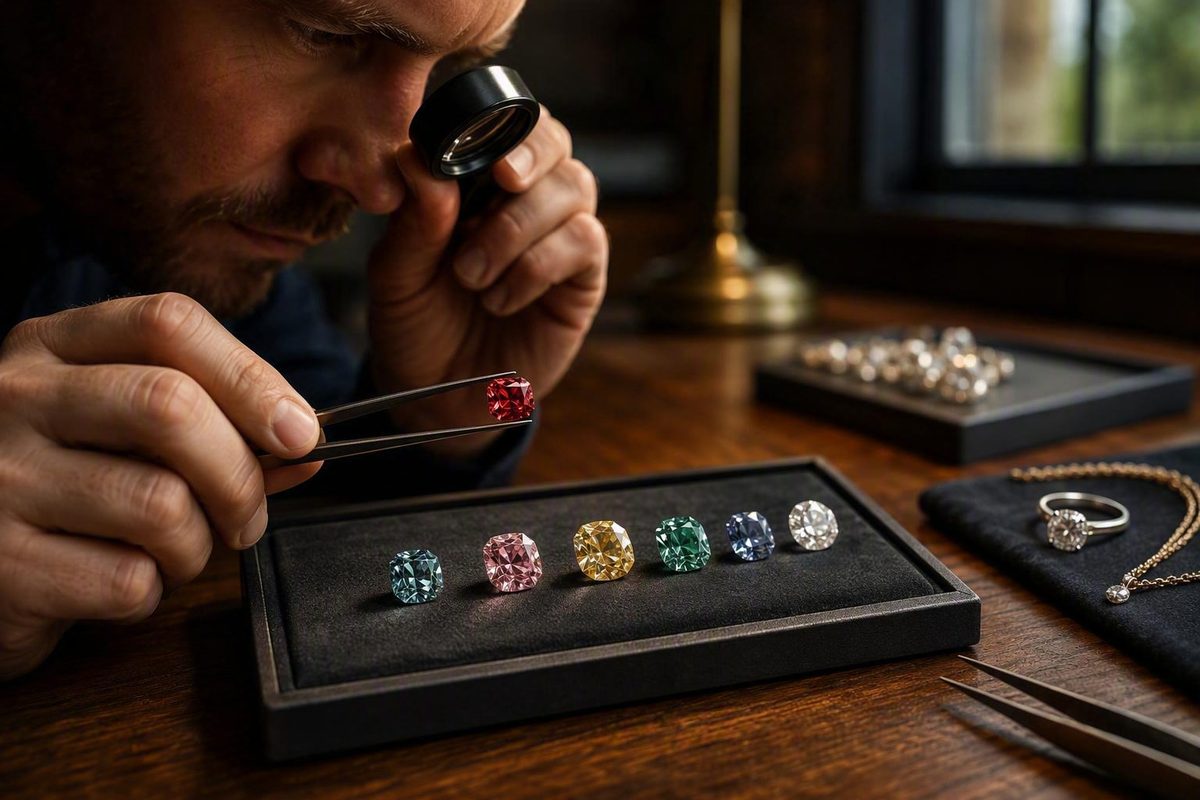
Updated September 6, 2026
Editorial note: This guide separates independent gemological guidance from commercial price estimates. Retailer figures are identified as such and should not be treated as appraisals or market-wide benchmarks.
The short answer: natural red usually leads per carat
Natural red is generally regarded as the most expensive diamond color on a typical per-carat basis. This is a market generalization, not a rule that makes every red diamond more valuable than every pink, blue, green, yellow, or D-color diamond. Commercial market guides commonly place natural red first per carat, but their conclusions are not based on a transparent, universal transaction index. G Marie, for example, identifies natural red as the per-carat leader while qualifying its estimates by color, size, clarity, provenance, and market conditions.
The Gemological Institute of America does not publish a fixed league table of diamond colors by price. GIA describes red and reddish diamonds as extremely rare and highly valued while identifying saturated pink, blue, and green diamonds as among the rarest and most valuable fancy colors. It also emphasizes that even slight color differences can materially affect value. GIA’s fancy-color quality guide explains these distinctions.
A useful answer therefore depends on the question being asked:
- What is the rarest diamond color? Natural red is widely treated as the leading answer.
- Which color usually commands the highest price per carat? Natural red is the category most often named by commercial market sources.
- Which individual diamond has achieved the highest publicly reported auction price? In the evidence considered here, that record belongs to a pink diamond rather than a red one.
These questions produce different answers because rarity, price per carat, and total sale price are not interchangeable. A very small red diamond can have an extraordinary per-carat valuation while costing less overall than a much larger pink or blue diamond.
The conclusion applies specifically to natural-color red diamonds supported by credible laboratory documentation. It does not automatically apply to a mined diamond whose color has been treated or to a laboratory-grown red diamond.
There is also no dependable fixed opening price for natural red. Commercial guides sometimes quote seven-figure per-carat estimates for collector-grade examples, but such figures are not transparent market-wide averages.
The defensible verdict is therefore narrow: among comparable natural fancy-color diamonds, red usually occupies the top category-level position per carat, but the complete identity and quality of the individual stone determine its actual value.
Why red diamonds can command exceptional prices
Extreme scarcity is the foundation of the natural red diamond’s market position. Scarcity alone, however, does not establish value. Buyers must also want the material, trust its identification and natural color origin, and be willing to compete for the limited supply. Commercial market commentary accordingly treats rarity and demand as joint influences rather than assuming that the scarcest color must win every sale.
Red coloration is associated with deformation or distortion in the diamond’s crystal lattice rather than the trace-element explanation used for certain other colors. Commercial gemological guidance commonly calls this plastic deformation and acknowledges that the exact process behind the red appearance is not fully understood. The same source identifies the 5.11-carat Moussaieff Red as an exceptionally large example and reports the often-repeated estimate that only about 20 to 30 natural red diamonds have been documented. That count should be treated as an unaudited industry estimate, not a complete global census. Paramount Jewelers provides the lattice-deformation explanation, Moussaieff weight, and estimated rarity count.
The Moussaieff Red illustrates how unusual substantial size is in this category. It does not establish a standard value for red diamonds, and estimates attached to that famous stone should not be transferred to another diamond.
Pure or comparatively unmodified red is especially unusual. Some red diamonds have secondary hues and may be described as purplish red or brownish red. A modifier is not automatically a defect: the full appearance may still be compelling. But two diamonds marketed simply as “red” can look very different, so the exact report wording matters more than the abbreviated sales label.
The strength and distribution of the face-up color matter as well. A red diamond that presents an even, unmistakable hue will not necessarily be valued like one that appears dark, uneven, or dominated by a secondary color. Buyers should also avoid inventing intensity grades from visual impressions. Fancy-color grading is specialized, and the terminology used for one hue should not be mechanically imposed on another. The exact grade printed on the laboratory report should control the description.
Scarcity further complicates comparison. When genuinely similar red diamonds seldom enter the public market, sellers and buyers have fewer completed transactions against which to assess a new stone. Comparisons may therefore involve imperfectly matched reds or elite diamonds of other colors. That limited evidence helps explain why commercial estimates vary and why no single per-carat figure can represent the category.
Natural red diamonds derive their market position from a combination of:
- exceptional natural scarcity;
- strong and attractive face-up color;
- collector demand;
- limited availability of close comparables;
- confidence in natural color origin;
- carat weight and dimensions;
- cut, shape, clarity, and transparency;
- provenance and documentation;
- and prevailing market conditions.
Rarity is the starting point, not a complete valuation.
Why D color and fancy red are not competing grades
A D-color diamond and a Fancy red diamond do not occupy opposite ends of one continuous color-price chart. They belong to different grading and valuation systems.
In the conventional D-to-Z color range, diamonds are assessed according to the relative absence of visible yellow or brown. D is the highest grade and represents the colorless end of the scale. Other qualities being equal, value generally rises as visible color decreases toward D. Natural fancy colors are evaluated separately. Blue Nile’s grading overview describes the D-to-Z scale and the separate treatment of fancy colors.
Fancy-color diamonds follow substantially different logic. Once a diamond qualifies for fancy-color grading, visible color is not something to minimize. Stronger and purer desirable color generally supports higher value, although tone, modifiers, appearance, size, and the other quality factors remain important.
| Comparison point | D-color diamond | Natural Fancy red diamond |
|---|---|---|
| Grading framework | Conventional D-to-Z scale | Separate fancy-color system |
| Grading objective | Assess absence of visible yellow or brown | Describe the visible hue and its face-up expression |
| Color direction generally associated with value | Less visible color toward D | Stronger, purer desirable color |
| Relevant terminology | D, E, F and onward through Z | Full color description, including any modifier and applicable strength terminology |
| Typical buyer priorities | Colorlessness, cut, clarity, carat weight, and overall balance | Natural color origin, exact grade, face-up color, rarity, size, and documentation |
| Common comparison error | Treating D as the best grade across all diamonds | Assuming any red-looking diamond outranks every colorless stone |
This distinction resolves an apparent contradiction in many buying guides. Colorless diamonds generally become more valuable as yellow or brown tint decreases, while fancy-color diamonds can become more valuable as desirable color strengthens. Both statements can be true because they refer to different grading frameworks.
D is rare within the conventional range, but that does not make every D diamond more expensive than every fancy-color diamond. A small D diamond with otherwise modest characteristics may cost less than a rare natural fancy color. A large, attractive D diamond may cost more in total than a tiny or less desirable fancy-color stone.
A meaningful comparison must control for carat weight, dimensions, cut, clarity, appearance, documentation, and market conditions. “D versus red” is not enough information to establish which diamond is worth more.
How red compares with pink, blue, green, and yellow
Natural red usually receives the headline as the highest-priced diamond color per carat, but pink, blue, green, and yellow occupy distinct positions in the fancy-color market. GIA identifies saturated pink, blue, and green as among the rarest and most valuable fancy colors. It also associates blue with boron, explains that natural radiation can produce green by displacing carbon atoms in the crystal structure, and identifies brown and yellow as the most common and second-most-common fancy colors, respectively. GIA provides the underlying rarity, color-cause, and quality comparisons.
| Color | Relative market position | Rarity context | Color cause, where supported | Important pricing caveats |
|---|---|---|---|---|
| Red | Most often described by commercial sources as the typical per-carat leader | Extremely rare, especially with a strong, comparatively pure red appearance | Associated with distortion or deformation of the crystal lattice; the exact process is not fully understood | Few close comparables; color origin, face-up strength, modifiers, and size matter greatly |
| Pink | One of the elite high-value fancy colors | Saturated pinks are among the rarest and most valuable fancy colors | Commonly associated with structural distortion rather than a simple trace-element cause | An exceptional pink can exceed a particular red in total price or price per carat |
| Blue | Among the most valuable fancy colors | Strong natural blue is extremely rare | Associated with boron | Gray or other modifiers, saturation, size, and demand can materially change value |
| Green | Potentially extremely rare and valuable | Saturated natural green is among the rarest fancy colors | Natural radiation can displace carbon atoms in the crystal structure | Laboratory testing cannot always determine whether green color is natural or treated |
| Yellow | A broad market ranging from relatively accessible fancy colors to exceptional stones | More common than elite red, pink, blue, and green categories | Associated with nitrogen | Intensity, purity, size, and appearance still create major price differences |
Red versus pink
Red usually takes the category-level per-carat lead in commercial guidance, but an individual pink can cost more overall or per carat. Size is particularly important when comparing total prices: a substantial, saturated pink may have a far greater total value than a tiny red even when the red belongs to the rarer category.
The boundary between color descriptions also matters. A report may describe a stone as pink, purplish pink, red, or purplish red. Buyers should use the complete laboratory grade rather than assuming a seller’s shortened color name captures the distinction.
Red versus blue
Natural blue combines exceptional rarity with high value. Boron is associated with the color, and gray may appear as part of the complete description.
A large, strongly colored blue with desirable overall characteristics can cost more than a smaller red.
Red versus green
Natural green requires especially careful attention to the laboratory report. Radiation can produce green color naturally, but treatment can also alter a diamond’s color. GIA notes that laboratory testing cannot always determine conclusively whether a green diamond’s color is natural or treated.
Green also demonstrates why rarity does not create a rigid price hierarchy. A color can be exceptionally scarce without invariably selling above a more widely sought hue. Demand, appearance, documentation, and the available buyer pool remain relevant.
Red versus yellow
It includes diamonds with widely different combinations of tone, saturation, size, modifier, and face-up appeal. Because fancy yellow is more common than elite red, pink, blue, or green, it generally does not hold the same category-level price position.
That does not make every yellow diamond inexpensive. A large, intensely colored yellow can command a substantial total price, while a tiny red can cost less overall. Category rarity cannot replace a stone-specific comparison.
The evidence therefore supports a qualified hierarchy rather than a fixed sequence: natural red is most often named as the per-carat leader; saturated pink, blue, and green also occupy the elite end of the market; yellow is more common; and individual results depend on the complete stone.
Color quality matters more than the color name alone
“Red diamond” is not a complete grade. Neither are “pink,” “blue,” “green,” or “yellow.” Within any hue, differences in color quality can produce substantial differences in appearance, rarity, and price.
Fancy-color assessment centers on several related characteristics:
- Hue: the principal color and any secondary color.
- Tone: how light or dark the color appears.
- Saturation: how strong or weak the color appears.
- Face-up presentation: how the polished diamond displays its color when viewed from above.
- Color distribution: how evenly the color appears across the stone.
GIA explains that fancy-color value generally rises with color strength and purity, that large vivid stones are exceptionally rare, and that attractive color can make a diamond prized even when its clarity grade is low. GIA’s fancy-color overview summarizes this valuation logic.
Intensity is not a universal price multiplier
Stronger desirable color generally supports value, but there is no defensible universal multiplier between color grades. Moving from one strength description to another does not automatically double or triple a diamond’s price.
The effect depends on the hue, tone, modifier, size, cut, distribution, and availability of comparable stones. A darker appearance is not necessarily better: greater depth of tone can make color look stronger, but it can also make a diamond appear less lively. The full visual result matters.
Even slight color differences can be commercially significant. Two diamonds with similar broad descriptions can present differently when compared in consistent lighting. One may show a more even or unmistakable hue, while another may appear muted, dark, or dominated by a secondary color.
Modifiers can change desirability
Secondary hues are part of a diamond’s identity. A red diamond might be described as purplish red or brownish red rather than simply red. Those descriptions should not be converted into an automatic percentage discount.
A purplish component may create an attractive result. A brownish component may make another diamond look less like the comparatively pure red some buyers seek. Yet a pleasing modified color may still be more desirable than a less modified stone with weaker or less attractive face-up color.
The proper comparison is the exact report wording plus the actual appearance—not a generic rule that every modifier is undesirable.
Clarity matters, but color can dominate
In fancy-color diamonds, color often carries greater weight than clarity. A lower clarity grade may be accepted when the natural color is exceptional and difficult to replace.
Clarity remains part of the valuation. Buyers should examine the type, size, position, and visibility of inclusions rather than relying only on the summary grade. For an expensive purchase, an independent gemologist should inspect the stone and explain any condition concerns before the transaction.
Cut serves the color
Fancy shapes, including radiant-style outlines, are commonly used to intensify color.
This does not mean cut stops mattering. It means that cut should be judged against the intended result. A diamond that displays strong, even color may have proportions that would not be preferred in a conventional colorless stone.
Shape also affects buyer preference and visual presentation. Appearance should therefore be evaluated alongside the report rather than inferred from shape alone.
The broader principle—judging a diamond in light of its cutting objective rather than applying one modern template mechanically—also matters when assessing antique cushion-cut diamonds, although antique and fancy-color cutting are distinct subjects.
The other quality factors remain active
Even when color dominates, valuation still considers:
- carat weight and dimensions;
- shape and face-up spread;
- cut and color performance;
- clarity and transparency;
- condition;
- polish and symmetry where relevant;
- documented provenance;
- laboratory findings;
- and current demand.
The color name attracts attention, but the interaction of these characteristics determines whether a particular diamond is exceptional, merely rare, or priced beyond the evidence.
The price depends on the stone, not just its hue
Yes, a pink or blue diamond can cost more than a red diamond. That can happen in total price, and it can also happen per carat when the stones are not closely matched.
A statement such as “red is usually the most expensive color per carat” describes a broad category-level tendency. It does not override the characteristics of two actual diamonds.
The principal price variables are:
- Exact color grade. The complete description reveals more than a simplified sales label.
- Color purity and distribution. Strong, even face-up color differs from dark, uneven, or heavily modified color.
- Natural color origin. Confirmed natural color belongs to a different comparison category from treated color.
- Carat weight and dimensions. Larger fancy-color diamonds are generally rarer, while dimensions affect apparent face-up size.
- Cut and shape. Cutting can strengthen color, preserve weight, and influence overall appeal.
- Clarity and transparency. These may be secondary to color but remain relevant.
- Provenance. Properly documented historical or collection associations may affect buyer interest.
- Demand. Preferences and the number of interested buyers can change the outcome.
- Laboratory documentation. A respected report reduces uncertainty about identification, grade, and color origin.
- Market timing. The available alternatives and competitive conditions at the time of sale can affect price.
Larger fancy-color diamonds are generally rarer and more valuable than smaller examples, but total price and price per carat are different measures. A larger diamond with a lower per-carat rate can cost much more overall than a tiny diamond with a higher per-carat rate.
The Pink Star illustrates the distinction. The 59.60-carat pink diamond sold for $71.2 million in April 2017, becoming the most expensive gem GIA then reported as having been sold at auction. The result reflects one exceptional stone and does not establish pink as the universally most expensive color. GIA records the Pink Star’s weight, sale date, and auction result.
Rare-diamond pricing is difficult to generalize because each stone has a distinct combination of color, weight, cut, clarity, and documentation. Public auction results are useful but represent only disclosed sales. Asking prices are not completed transactions, and private-sale information may be limited.
Some commercial guides estimate that collector-grade natural red diamonds can reach $1 million or more per carat. This should be treated as approximate, seller-published guidance rather than a fixed or independently verified market rate. A real valuation requires dated evidence for diamonds with genuinely comparable color, origin, size, modifiers, cut, clarity, and documentation.
Natural, treated, and laboratory-grown color are different markets
A naturally colored red diamond, a treated-color red diamond, and a laboratory-grown red diamond may look similar in a photograph. They are not economically equivalent categories.
A natural-color diamond formed naturally and acquired its color through natural processes. A treated-color diamond has had its appearance altered after formation. A laboratory-grown diamond was produced in a laboratory, although laboratory-grown material can have essentially the same chemical, physical, and optical properties as natural diamond.
Naturally colored diamonds generally command the largest rarity premiums, while treated-color diamonds are generally valued below comparable natural-color stones. G Marie distinguishes natural, treated, and laboratory-created color in its market guidance.
The listing and grading documentation should answer two separate questions:
- Is the diamond natural or laboratory-grown?
- If it is natural, is the color natural, treated, or not conclusively determined?
Those questions are easily blurred. “Natural diamond” does not necessarily mean “natural color,” because a mined diamond can still have undergone treatment.
Appearance alone cannot establish origin. A vivid red face-up color shows what the diamond looks like, not how it formed or how the color arose.
The laboratory report should therefore be read for its exact conclusion and any limitations. This is particularly important with green diamonds, for which natural and treated color cannot always be distinguished conclusively. The price should not assume a level of certainty that the report itself does not provide.
A report-first checklist for evaluating a colored diamond
A rare-color claim should begin the due-diligence process, not end it. Work from independent documentation toward the seller’s description, rather than using the sales description to interpret the report.
1. Obtain an independent gemological report
Do not rely only on an invoice, appraisal, seller-created certificate, or marketing description. Ask for a report from an established independent gemological laboratory with appropriate colored-diamond expertise.
A grading report does not determine whether the asking price is fair. It does provide a necessary basis for identifying and comparing the stone.
When a report-check service is available, verify the report number and confirm that its weight, measurements, shape, and identifying details correspond to the diamond being offered.
2. Confirm diamond origin
Record whether the report identifies the stone as:
- a natural diamond;
- a laboratory-grown diamond;
- or another material or product.
Do not infer origin from the unqualified word “diamond” in a listing. Natural and laboratory-grown stones belong to different comparison markets.
3. Confirm color origin and treatment findings
For a natural diamond, determine whether the report identifies the color as natural, treated, or not conclusively determined. Read comments and supplementary statements rather than relying only on the headline grade.
If a seller makes a stronger color-origin claim than the laboratory does, request better documentation rather than assuming the sales description is correct.
4. Copy the complete color description
Record every part of the reported color grade, including:
- dominant hue;
- applicable color-strength description;
- secondary modifier;
- and any comments about distribution.
Do not compare “red” with “red” or “blue” with “blue” using shortened listing labels. A purplish red is not identical to a brownish red, and a grayish blue is not identical to a more purely blue diamond.
5. Examine face-up appearance consistently
A report cannot fully communicate visual appeal. View the diamond:
- face-up rather than only from the side;
- under neutral, diffused lighting;
- against a neutral background;
- in more than one realistic environment;
- and, for remote purchases, through video that has not been visibly enhanced.
Compare color strength, evenness, brightness, dark areas, and how the appearance changes as the diamond moves. Ask whether the setting, metal, backing, or neighboring stones are influencing the apparent color.
6. Compare weight, dimensions, cut, and shape
Carat weight is not the same as visible size. Compare the measurements and face-up spread as well as the weight.
Consider whether the cut presents the color attractively and evenly. Do not transfer the standards used for a round colorless diamond mechanically to every fancy-color shape, but do not excuse an unattractive result simply because the stone was “cut for color.”
7. Review clarity and condition
Clarity may be secondary to color, but it should not be ignored. Review the report and have a qualified professional inspect the diamond, particularly when inclusions or condition concerns are material to the purchase.
The relevant question is not whether the diamond meets colorless-diamond ideals. It is whether its clarity and condition are acceptable for that particular stone and price.
8. Evaluate provenance separately
Provenance can influence buyer interest, but it requires documentation. Claims about a previous owner, collection, mine, or historical event should be supported by appropriate records.
Possible evidence includes prior reports, auction catalog entries, dated invoices, ownership records, or archival photographs. An unsupported story should not be treated as proof of added value.
Do not infer geographic or mine origin from color alone. A grading report establishes only the conclusions covered by that laboratory service.
9. Build a genuinely comparable price set
Compare diamonds that are reasonably close in:
- natural or laboratory-grown origin;
- natural or treated color;
- hue and modifier;
- color strength and tone;
- carat weight and dimensions;
- shape and cut;
- clarity and transparency;
- documented provenance;
- report type;
- transaction date;
- and sale context.
Do not compare a small modified red with a large Fancy Vivid pink merely by dividing each headline price by carat. The calculation may look precise while ignoring most of the variables that determine value.
Completed sales are generally more informative than asking prices, although even completed transactions must be interpreted in light of the stone and sale circumstances.
10. Treat seller price guides as context
A seller’s published range may indicate the claimed scale of the market, but it does not prove the value of the diamond being offered. Ask what dated comparable transactions support the price.
Clarify its valuation basis, effective date, and intended use.
For a major purchase, consider advice from an independent specialist who does not own the stone and is not compensated according to whether the sale closes.
11. Account for timing and demand
Rare diamonds are not standardized commodities. The alternatives available at a given time and the level of collector demand can influence both asking prices and completed sales.
Do not present rarity, past auction records, retailer commentary, or the closure of a producing mine as a guarantee of appreciation. None of those factors ensures a future return.
12. Make the final comparison stone by stone
A practical comparison worksheet might include:
| Field | Diamond A | Diamond B |
|---|---|---|
| Natural or laboratory-grown | ||
| Natural, treated, or undetermined color | ||
| Full color grade | ||
| Modifier | ||
| Carat weight | ||
| Dimensions | ||
| Shape and cut | ||
| Clarity and transparency | ||
| Face-up strengths and weaknesses | ||
| Report issuer and date | ||
| Documented provenance | ||
| Asking price | ||
| Price per carat | ||
| Comparable completed sales |
This structure prevents the word “red” from doing more valuation work than it deserves.
The qualified verdict
Natural red usually occupies the top per-carat position in broad market discussions, but a color name is not a valuation. The price of a specific diamond depends on its complete color grade, natural origin, size, cut, clarity, appearance, provenance, documentation, demand, and the market at the time.
Buyers should prioritize an independent laboratory report and like-for-like evidence over absolute rankings, seller estimates, or promises of investment performance.
Frequently asked questions
Is red always the most expensive diamond color?
No. Natural red is generally regarded as the highest-priced color on a typical per-carat basis, but no hue wins every individual comparison.
A large, strongly colored, well-documented pink or blue diamond can cost more overall than a small red. A particular pink, blue, or green may also achieve a higher price per carat than a particular red because of its color, size, provenance, documentation, or demand.
GIA does not publish a strict universal price ranking. The safe conclusion is that natural red usually leads at category level, not that red always wins.
How much does a natural red diamond cost per carat?
There is no dependable fixed price per carat. Some retailer guides quote approximately $1 million or more per carat for collector-grade natural red diamonds, but those figures are commercial estimates rather than transparent, independently verified market averages. Paramount Jewelers publishes a seven-figure estimate while also noting that diamond characteristics affect price.
Actual pricing can change sharply with color strength, modifiers, natural color-origin findings, carat weight, dimensions, cut, clarity, provenance, documentation, and market timing. For a real stone, use its laboratory report, face-up assessment, and dated comparable transactions rather than a generic per-carat range.
Is a D-color diamond more valuable than a fancy-color diamond?
Not necessarily. D is the highest grade in the conventional D-to-Z system, where less visible yellow or brown generally supports value. Fancy-color diamonds are graded separately, and stronger, purer desirable color generally supports value in that market.
A D-color diamond may be worth more if it is larger or otherwise more desirable. A rare natural fancy-color diamond may be worth far more than a D-color stone. Neither label establishes price without the remaining specifications.
What is the difference between the most expensive color per carat and the most expensive diamond ever sold?
“Most expensive color per carat” is a category-level claim. It asks which hue typically commands the greatest price relative to weight; commercial guidance most often gives that distinction to natural red.
A public auction record concerns one specific diamond’s total transaction price. The 59.60-carat Pink Star sold for $71.2 million in 2017, a result attributed to one exceptional pink diamond rather than to every diamond of that hue. Calvin’s Fine Jewelry records the Pink Star’s weight, sale price, and year.
That public auction result does not establish the highest price in every private or undisclosed transaction, nor does it prove that pink diamonds always cost more per carat than red diamonds.
Does clarity matter for a fancy-color diamond?
Yes, although color is often the dominant quality factor. A fancy-color diamond with exceptional natural color can remain highly prized despite a lower clarity grade.
Clarity still forms part of the stone-specific assessment. Buyers should consider the type, position, and visibility of inclusions and obtain an independent professional inspection when appropriate. The relevant question is whether clarity materially compromises the particular diamond—not whether it meets the standards a buyer might apply to a conventional colorless stone.