
Double Prong Engagement Ring Guide: Pros, Cons & Buying Tips
A double prong engagement ring can look delicate, architectural, or distinctly antique-inspired. Paired claws may also create more points of contact around a…
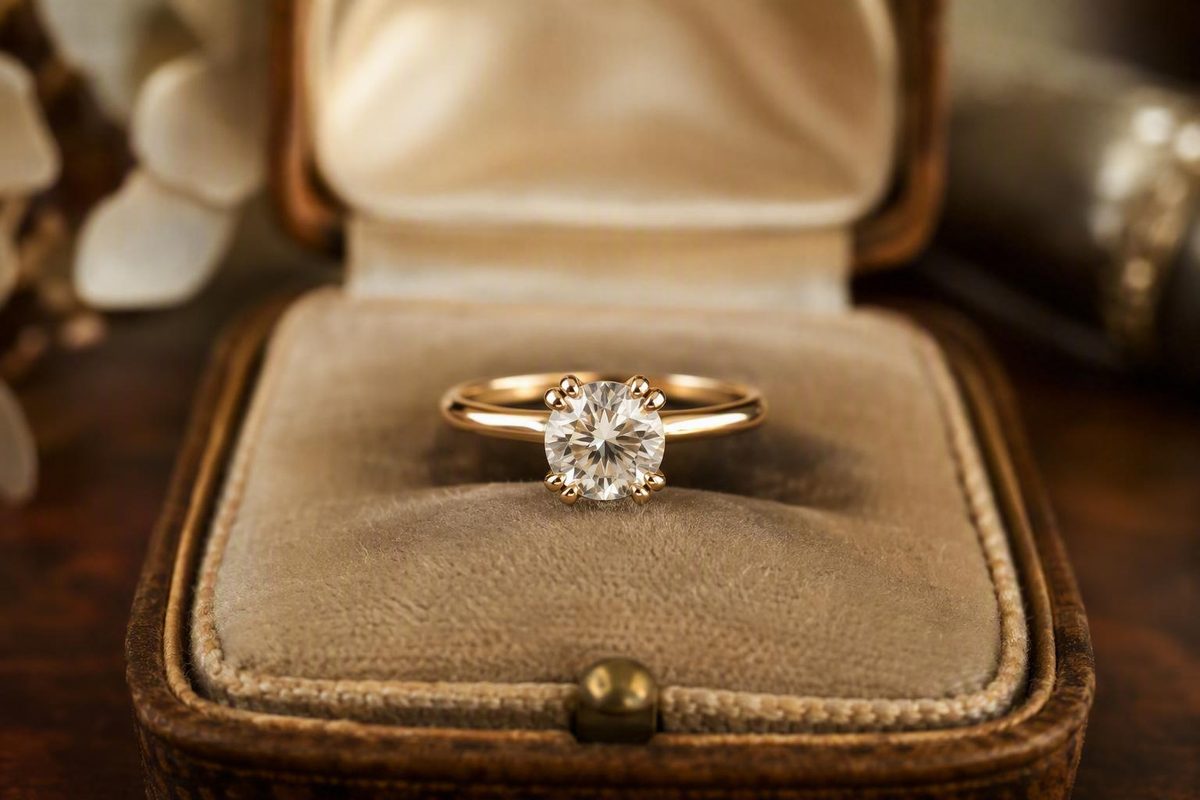
A double prong engagement ring can look delicate, architectural, or distinctly antique-inspired. Paired claws may also create more points of contact around a center diamond or gemstone. But neither the “double prong” label nor the number of visible tips proves that a setting is safer.
The more useful questions are specific: How accurately are the seats cut? Do the claws make close contact with the stone? Do the paired tips emerge from separate stems or a shared base? Are they proportioned to the stone? Do vulnerable corners receive suitable coverage? Is the head practical for your lifestyle, and will the intended wedding band clear the basket?
Use those questions—not seller terminology alone—to decide whether paired claws suit your center stone, budget, and daily wear.
What a double-prong engagement ring actually is
A prong is a narrow metal component that helps hold a center stone in place. In a conventional prong setting, one tip extends over the stone at each perimeter contact location. A double-prong design generally places two slimmer tips at each location instead of one thicker tip.
Three separate counts may therefore matter:
- Perimeter contact locations: The places around the stone where prong tips meet it.
- Visible tips: The individual claw ends seen from above.
- Structural stems or bases: The components beneath those tips, which may be separate, joined, or split near the top.
For example, a rectangular stone may have four perimeter contact locations, one at each corner. If each location contains a pair, the ring has four paired positions and eight visible tips. Some sellers still classify this as a four-prong setting because they count the four locations rather than the individual tips. Lauren B uses that convention for its illustrated double-claw design, describing four positions containing two side-by-side claws each (Lauren B’s setting comparison).
This is why “four prongs” and “eight prongs” can sometimes describe the same face-up arrangement. Before comparing rings, ask the seller to state:
- How many perimeter contact locations are used?
- How many individual tips touch the center stone?
- How many stems or bases support those tips?
- Where, if anywhere, do paired elements join?
Double claw, paired claw, and split claw are not reliable synonyms
One jeweler may use “double claw” for two distinct stems placed side by side. Another may use the term for one wider element that divides near the crown. A split claw can look like two tips from above while retaining a common base below.
Do not infer structural independence from a face-up photograph. Instead, ask the jeweler to identify the construction and explain how a damaged tip, stem, or shared base would be repaired. Whether separate stems behave differently under a particular impact is a question for the maker evaluating the actual design—not a conclusion that can be drawn from the label.
Request:
- A close-up photograph from directly above
- A side profile showing the prong stems
- An underside view of the basket or head
- A construction drawing for a custom ring
- A written description of where each claw begins and whether any elements share a base
Also distinguish center-stone paired prongs from shared prongs. A shared prong sits between two adjacent accent stones and helps retain both. Whiteflash’s guide distinguishes center-stone prong styles from shared prongs used between neighboring accent stones (Whiteflash’s prong-setting guide).
Finally, tip shape is primarily an aesthetic and finishing choice. Tapered, pointed claws create a sharper or more vintage-inspired frame; rounded paired tips create a softer outline. Neither shape alone guarantees better retention, lower snagging, or greater durability.
How paired claws hold the stone—and what good workmanship looks like
A secure prong setting depends on fitted contact, not metal merely hovering above the stone.
Before setting, the prongs extend upward around the center opening. The jeweler cuts a seat into the inside of each prong, rests the stone’s girdle in those seats, and bends or burnishes the upper metal over the crown. The stone should sit evenly, with the seats positioned to provide close support without obvious gaps or visibly uneven pressure.
Double claws make the work especially noticeable because each pair must look balanced while fitting the stone. In a demonstrated hand-setting workflow for an emerald-cut, double-claw three-stone ring, the jeweler checked that the center sat evenly, refined the inner surfaces and separation between each pair, tightened the claws gradually, trimmed and shaped the tips, and tested the finished setting for rattling (Ruru’s Rings double-claw setting demonstration).
That demonstration reflects one maker’s process, not a controlled manufacturing standard. It nevertheless illustrates why the final result cannot be judged by prong count alone. Eight attractively shaped tips are of little value if the stone is tilted, the seats are poorly fitted, or some claws do not make effective contact.
What to inspect in close-up images
Review the actual ring—or the closest genuinely comparable finished example—under magnification. Look for:
- A centered, level stone. It should not appear tilted toward one side.
- Balanced pairs. Gaps within and between pairs should look intentional and reasonably consistent.
- Consistent tip dimensions. One claw should not look conspicuously shorter, thinner, or heavier than its partner without an explained reason.
- Close contact. There should be no obvious daylight beneath a tip where contact is intended.
- Appropriate corner alignment. On angular shapes, the pairs should frame the corners rather than sit visibly off-center.
- Smooth finishing. Tips should look polished, not jagged, torn, or roughly filed.
- No exposed unfinished edges. A sharp or irregular edge should be corrected.
- No movement. A stone that shifts, clicks, or rattles needs professional attention.
Symmetry matters visually, but perfect mirroring is not the only objective. Functional contact and suitable support should take priority over forcing an uneven outline into a mathematically uniform pattern.
The demonstrated jeweler also cautions against repeatedly or excessively bending prongs because overworking the metal can weaken or break it. That is bench experience rather than quantified durability research, but it supports two practical rules: do not attempt at-home prong adjustment, and ask how the jeweler plans to correct any misaligned claw before more metal is moved.
Security ultimately depends on the seats, claw dimensions, head geometry, stone fit, craftsmanship, metal condition, impacts, wear, and maintenance. Visible tip count is only one part of that system.
Are double prongs more secure than four prongs, six prongs, V-prongs, or a bezel?
Several retailer guides describe paired claws as adding hold or security. The proposed benefit is plausible: two tips at a contact location may provide some restraint if one is damaged. The supplied evidence, however, contains no standardized impact testing or quantified failure data proving that double claws outperform every four-prong, six-prong, V-prong, or bezel setting.
Paired claws are also often slimmer than single claws, and two visible tips may arise from a shared stem or base. Eight visible tips should therefore not be treated as eight fully independent safeguards.
Evidence limit: The comparisons below synthesize retailer education, product descriptions, and one maker demonstration. They are useful for identifying questions and design tradeoffs, but they are not an engineering ranking of setting failure rates.
At-a-glance comparison
| Setting | Typical visual effect | Coverage and retention considerations | Especially worth comparing when |
|---|---|---|---|
| Four single prongs | Open, minimal-metal appearance | Four distributed contact locations; performance depends on dimensions, seats, and condition | You want an open face-up view or a squared four-corner composition |
| Four paired positions | Delicate pairs or an antique-inspired frame | More visible tips, but not necessarily more independent stems or bases | The paired-claw look complements the stone and construction can be verified |
| Six prongs | More continuous rhythm around the perimeter | Two more contact locations than a conventional four-prong arrangement | You want distributed support and accept additional visible metal |
| V-prongs | Metal wraps a pointed end or corner | Purposeful coverage for vulnerable points | Pear, marquise, or princess shapes |
| Full bezel | Continuous or near-continuous rim | More perimeter coverage and fewer projecting tips than an open prong setting | A smooth perimeter, lower snag potential, or greater edge coverage is the priority |
Workmanship and exact geometry override these general categories.
Four single prongs
A conventional four-prong setting usually places less visible metal around the stone than many six-prong or paired-claw layouts. It can create an open appearance and preserve a squared outline when the prongs sit at four corners.
The tradeoff is that it has fewer contact locations than a conventional six-prong setting. If one prong becomes seriously damaged, the remaining distribution of support changes. Even so, an accurately seated, appropriately proportioned four-prong head can be preferable to a poorly made setting with more tips.
Six prongs
A conventional six-prong head adds two contact locations relative to a four-prong head. Depending on the layout and condition of the other prongs, those additional positions may continue to restrain the stone if one prong is damaged. They also add visible metal and can change the apparent outline of the center stone.
On a round stone, six evenly spaced prongs can create a balanced, scalloped rhythm. On an oval, their placement may make the outline appear more rounded or otherwise alter its visual proportions. Inspect the actual design rather than relying on a generic diagram.
Six prongs are not automatically stronger in every execution. Thin, worn, poorly seated, or badly aligned prongs remain vulnerabilities regardless of count.
V-prongs
A V-prong wraps around a pointed end rather than placing only a small tip on its upper surface. It is therefore an important comparison for pear, marquise, and princess shapes. Whiteflash identifies V-prongs as a shape-specific option for these pointed stones, although that guidance is a retailer recommendation rather than comparative test data.
When considering paired claws near a pear tip, marquise point, or princess corner, ask exactly how much metal surrounds the vulnerable area. A well-proportioned V-prong may provide more purposeful point coverage in one design, while a custom paired arrangement may be appropriate in another.
Full bezel
A full bezel surrounds the sides of the stone with a continuous or near-continuous rim. It generally provides more perimeter coverage than an open prong setting and has fewer projecting tips that can catch surrounding material. It also creates a more visible border around the stone. Lauren B’s comparison places the bezel above conventional four- and six-prong settings for protection, but it provides no controlled testing or quantified failure rates.
A bezel is not a guarantee against damage, loosening, or loss. Its performance still depends on fit, construction, wear, and workmanship. It is nevertheless a useful direct comparison if your priorities are edge coverage or a smoother perimeter.
The most useful security questions are therefore:
- How many useful perimeter contact locations are present?
- How many tips, stems, and bases are involved?
- Are any elements structurally shared?
- How thick and well supported are the claws?
- How precisely do the seats fit this stone?
- How much of each vulnerable point or edge is covered?
- How exposed is the head to impacts?
- How would a damaged component be repaired?
- What inspection and maintenance support is included?
A carefully made setting with fewer prongs can be a better purchase than a worn or poorly seated setting with more metal.
Choosing paired prongs for each center-stone shape
Current retailer examples and guides show double claws with oval, emerald, radiant, cushion, and round center stones. That demonstrates versatility, not universal suitability. The right arrangement depends on the stone’s actual length, width, depth, outline, girdle, corners, and orientation.
Carat weight is not a complete fit measurement. Give the jeweler the grading documentation and millimeter measurements, then have the physical stone assessed whenever possible.
Oval
Paired claws can frame an oval at four diagonal positions or in another intentionally balanced layout. Placement affects how clearly the elongated outline remains visible.
Pairs positioned too far toward the sides may visually shorten or widen the stone. Oversized claws can interrupt its curves, while very small tips may be unsuitable for the head’s required dimensions. Ask to see the proposed setting with an oval of similar length and width—not merely the same carat weight.
Compare the face-up view with a six-prong oval. The six-prong version will create a different rhythm around the perimeter, but neither arrangement is universally preferable.
Emerald cut
Double claws are particularly recognizable on emerald cuts because paired tips at the four corners echo the geometric outline. Precise alignment matters: uneven pairs are conspicuous beside straight facet lines and clipped corners.
The jeweler must decide where each seat will contact the stone and how much corner coverage the design provides. A delicate point positioned near a corner is not necessarily the same as a prong that supports and covers it appropriately.
Radiant cut
A radiant can also take paired claws at its corners, creating a crisp geometric frame.
Request images of a setting made for similar dimensions. Plum’s double-prong cathedral listing uses a radiant example while offering customization for other shapes, illustrating why the ordered configuration should be confirmed rather than inferred from the sample photograph (Plum’s Radiant Cut Double Prong Cathedral).
Cushion and old-mine-style cushion
Cushions can pair well with claw styling because their rounded or clipped corners allow different visual interpretations. Pointed claws can reinforce an antique-inspired or angular look, while rounded pairs create a softer frame.
Old-mine-style and antique cushions may have individually varied or slightly asymmetric outlines. A stock head should not be assumed to fit simply because it is labeled “cushion.” If this is the aesthetic you are considering, first review how antique cushion-cut diamonds differ from modern cushions, then ask the jeweler to assess every corner of the actual stone.
Poorly scaled double claws can obscure the outline or compete with a broad, pillowy shape. A custom head or carefully modified stock head may be needed, but compatibility should be determined from the physical stone rather than the category name.
Round
With a round center, compare four paired locations with a conventional six-prong arrangement. Four pairs create distinct groupings around the circumference; six single prongs create a more continuous visual rhythm.
Look at the ring face-up and at normal viewing distance.
Pear, marquise, and princess
These shapes require deliberate point or corner protection. Do not assume paired claws are automatically the safest choice because more tips are visible.
For a pear, inspect the treatment of the single point. For a marquise, inspect both ends. For a princess, inspect all four corners and ask whether V-prongs, corner-covering prongs, or a bezel would provide more suitable coverage.
The relevant question is not how many tips appear in a top-view photograph. It is how the setting supports and surrounds each vulnerable point on the actual stone.
When double claws look crowded
There is no supported universal carat threshold below which paired claws become too bulky. Visual crowding depends on the stone’s dimensions and the scale, angle, spacing, and finish of the tips.
A smaller face-up stone can look balanced with exceptionally fine, well-proportioned pairs. A larger stone can look cluttered if the claws are thick or badly placed. Ask for a scaled rendering and a comparable finished example, while remembering that a rendering cannot prove final seat contact, polish, or alignment.
Style and daily-wear tradeoffs
Paired claws contribute visibly to the design rather than disappearing completely. Decide whether you want to notice them.
Pointed claws can read as sharp, floral, geometric, or vintage-inspired depending on their placement. Rounded pairs generally create a softer frame. In either case, the tips must remain substantial enough for their role and smooth enough for regular wear.
Stone visibility and sparkle
Slim paired claws may appear more delicate than thick single prongs. At the same time, two tips can cover more perimeter than one. The result depends on their dimensions, spacing, angle, and placement.
The supplied sources do not quantify light-performance differences between double and single prongs. Do not accept “more sparkle” or “less sparkle” as an automatic consequence of tip count. Judge the visible metal directly and consider the stone’s cut quality separately.
Snagging and cleaning
Any projecting prong can catch fabric if it becomes raised, bent, worn, separated from the stone, or poorly finished. Retailer care guidance also identifies snagging as a possible sign of a loose or worn prong, so a new tendency to catch clothing deserves inspection rather than being dismissed as a minor inconvenience (Yadav’s prong-setting guide).
A well-finished pair should have smooth surfaces and close contact where intended.
Lifestyle scenarios
Consider how the ring will encounter the world:
- Frequent glove use: A high center or projecting tip may catch as gloves go on or come off.
- Childcare: Repeated lifting and hurried hand movements may make a smoother or lower-profile perimeter more practical.
- Healthcare: Gloves, frequent handwashing, and workplace restrictions may favor a lower head or a separate work band.
- Exercise: Equipment and hard surfaces can expose a setting to pressure or impact; removing the ring may be more practical.
- Manual work: Repeated knocks, tools, and gripping make a bezel, low-profile head, or robust prong arrangement worth comparing.
- Active everyday wear: More frequent checks may be prudent, particularly after a hard impact.
An active lifestyle does not make paired claws categorically right or wrong. Setting height, exposed edges, finish, head support, wear habits, and willingness to remove the ring all matter.
Pavé on claws and hidden accents
Pavé-set prongs add visual detail but introduce additional stones and surfaces to inspect. In a PriceScope discussion, participants expressed concern about durability and abrasion where pavé prongs meet an adjacent wedding band, while others reported satisfactory experiences with protected hidden halos. These are consumer opinions and anecdotes, not controlled evidence of comparative failure rates (PriceScope discussion of pavé prongs and adjacent bands).
If durability is your leading criterion, compare:
- Plain paired claws
- A protected hidden halo
- A lower-profile head
- A conventional six-prong setting
- A full or partial bezel
Inspect the exact surfaces that could contact a wedding band. “Hidden” does not necessarily mean isolated from rubbing or wear.
Wedding-band fit: when a double-prong ring will stack flush
A flush stack means the wedding band can sit beside the engagement ring without a deliberate gap. Some buyers prefer that continuous look; others intentionally choose visible separation. Neither is inherently correct.
Paired claws alone do not determine whether a ring stacks flush. Clearance depends on the full profile, including:
- Basket width and height
- Where the head joins the shank
- Cathedral shoulders
- An integrated basket
- A hidden halo
- Accent stones or exposed pavé
- Gallery rails and support bars
- The wedding band’s own height, width, and setting style
A cathedral design raises the shoulders toward the center and may support the head, but it does not guarantee that a straight band will pass beneath it.
In the supplied snapshot of Hera’s prong-set collection, the retailer’s own filters categorized 79 designs as stacking flush and 29 as not stacking flush. Those are seller-applied collection counts and can change, but they demonstrate that “prong set” does not answer the fit question (Hera’s prong-set collection).
How to check fit before ordering
- View both rings from the side. A face-up image cannot show whether the band strikes the basket.
- Identify the first contact point. Determine whether the band touches a support bar, halo, prong base, accent stone, or cathedral shoulder.
- Check for surface-to-surface wear. Exposed pavé or diamond edges should not grind against vulnerable metal or stones in the neighboring ring.
- Try the intended band. A generic “stacks flush” description may not apply to a tall, wide, shared-prong, or unusually contoured wedding band.
- Confirm the ordered proportions. Samples and renderings may use a different finger size or center stone.
- Get compatibility in writing. When buying the rings separately or commissioning custom work, request written confirmation for the exact designs and dimensions.
If a straight band will not clear the head, possible responses include a curved or contoured band, an open band, or a spacer. These are options, not automatic requirements. You may also prefer the gap and leave the engagement ring unchanged.
What double-prong engagement rings cost—and why listed prices are easy to misread
There is no useful single price for a double prong engagement ring. The first question is what the advertised amount actually buys.
Four different offer types
- Complete ring: The setting and a specified center stone are included.
- Setting-only purchase: The quoted amount covers the mounting but excludes the center stone.
- Semi-mount: The ring is substantially finished, often with accent stones, but awaits its center stone.
- Promotional bundle: A seller temporarily includes a center stone or offers an upgrade under separate conditions.
These categories are not interchangeable. Confirm the exact inclusions before comparing prices.
Current listing examples
Hera’s supplied collection snapshot listed the Zelda Old Mine Cut from $1,800 and the Archer Oval from $1,700. The Zelda was shown with compass-set paired claws and an old-mine-style cushion option; the Archer was shown with an oval center and double claws. These are seller-provided starting prices, and the selected center stone, configuration, availability, and current inclusions require confirmation on the individual order page.
Plum listed its Radiant Cut Double Prong Cathedral at $1,640 for the setting only. The displayed ring used a 3.5-carat radiant lab diamond as an example rather than as part of the base price. The listing also stated an approximate four-week production period. All are seller-provided details subject to change (Plum’s setting-only listing).
Thompson Jewelers listed a 14kt yellow-gold semi-mount at $3,408. Its base description excluded the center stone and specified accommodation for an 8.0 mm round center, while separate promotional text said a 1-carat lab-grown diamond was included with eligible mountings. Because those statements conflict, obtain written confirmation of the current price, qualifying mounting, center-stone specifications, availability, and promotion terms before paying (Thompson Jewelers’ semi-mount listing).
These examples are not like-for-like. They differ in product type, center-stone inclusion, metal, accents, design, customization, and seller policies. They should not be averaged into a supposed market price.
A total-cost worksheet
Ask for an itemized quote covering:
- Setting or semi-mount
- Center diamond or gemstone
- Grading documentation
- Metal and upgrades
- Custom head or basket work
- Stone-setting labor
- Accent stones or hidden halo
- Engraving or hidden birthstones
- Sales tax
- Insured shipping
- Initial and future resizing
- Insurance
- Inspection and maintenance
- Future retipping or head work
- Compatible wedding band or spacer
For fit, provide the stone’s length, width, depth, outline, corner geometry, and orientation—not carat weight alone. Ask whether the quote includes any head modification required for that exact stone.
Prices, availability, production times, promotions, and service policies are seller-provided snapshots. Recheck them immediately before purchase and retain the final product description, correspondence, and invoice.
A pre-purchase checklist for comparing designs and jewelers
A sound buying process turns a vague style label into a specific construction and service agreement.
Confirm what the quote includes
Ask whether the purchase is:
- A complete ring
- A setting only
- A semi-mount
- A temporary promotional package
Obtain an itemized description of the center stone, side stones, hidden accents, grading reports, setting labor, engraving, and customization. If promotional copy conflicts with the main product description, do not assume the more favorable interpretation is correct.
Document the center stone and prong layout
Request:
- Exact length, width, and depth
- Intended north-south or east-west orientation
- Girdle and corner assessment
- Number of perimeter contact locations
- Number of visible tips
- Number of stems or bases
- Tip shape and approximate scale
- An explanation of where paired claws join, if applicable
- A description of how pointed corners or ends are covered
For an existing stone, require an in-person assessment before accepting a promise that it can be reset. Generic compatibility rules cannot account for prior damage, girdle condition, unusual proportions, or the dimensions of an existing head.
Inspect the real construction
Ask for close-up top, profile, and underside images of the actual ring. If it has not yet been made, request images of a genuinely comparable finished piece plus the custom drawing.
Renderings are useful for proportion and layout, but they do not prove:
- Seat contact
- Final claw thickness
- Smooth polishing
- Stone alignment
- Absence of gaps
- Repairability
- Wedding-band clearance
Ask how high the stone will sit, how the head is made, how it joins the shank, and how a damaged tip, stem, or shared base would be repaired.
Verify dimensions and policies
Record:
- Metal and alloy
- Band width and depth
- Ring size
- Center- and accent-stone documentation
- Customization limits
- Production time
- Insured shipping and signature requirements
- Return or exchange conditions
- Resize eligibility and exclusions
- Inspection and maintenance coverage
- Who pays shipping during service
- Whether third-party work affects coverage
As an example of the detail a product page may disclose, Plum’s listing specified a 2 mm band width, 1.8 mm depth, setting-only status, sizes from 3 through 13 in quarter increments, customization options, and an approximate four-week production period. Those details apply only to that listed design and may change; they are not default specifications for double-prong rings.
Confirm the wedding-band plan
Try the exact wedding band where possible. Otherwise, exchange profile drawings or measurements and obtain a written compatibility statement. Clarify whether “flush” means:
- No visible gap from above
- No contact while the rings are at rest
- Enough clearance to avoid rubbing during ordinary movement
Those are not necessarily the same promise.
Consider an independent inspection
An independent inspection is especially sensible when:
- The center stone is valuable
- The head is highly customized
- The prongs have been substantially modified
- An existing stone is being reset
- The seller’s inclusion terms are unclear
- Close-up images show possible gaps or asymmetry
- The ring arrives with catching, clicking, or movement
The inspector should evaluate the actual stone and setting, not merely confirm that the invoice says “double prong.”
Cleaning, inspections, and warning signs after purchase
Paired claws remain prongs. They can loosen, bend, break, thin through wear, or begin catching over time. Regular attention cannot make a ring damage-proof, but it can identify changes before they become more serious.
Retailer guidance commonly recommends professional inspection every six to twelve months. VRAI, for example, advises checks in that range and notes that a professional jeweler may retip or replace worn prongs (VRAI’s prong care guidance). Treat that interval as a general maintenance schedule, not a guarantee against stone loss or a universal engineering standard.
Arrange an earlier inspection after:
- A hard impact
- Forcefully catching the ring
- A period of unusually active wear
- A change in how the ring feels
- Any concern about the stone or claws
Warning signs that need prompt attention
Watch for:
- Fabric catching where it did not before
- A new sharp edge
- A visible gap beneath a claw
- Bent, lifted, or uneven tips
- Noticeably thinning metal
- Clicking or rattling
- Any movement of the center stone
If the stone moves or a claw appears damaged, stop wearing the ring and store it securely until a qualified jeweler can inspect it. Do not push a tip down, repeatedly test the stone, or attempt to tighten the setting with household tools. The maker demonstration cited earlier specifically cautions against repeatedly working prong metal.
Gentle home cleaning
If the ring appears secure, routine cleaning can be simple:
- Prepare warm water with a small amount of mild soap.
- Allow surface residue to soften briefly.
- Use a soft-bristled brush gently around the basket and underside.
- Rinse carefully in a separate bowl or over a closed drain.
- Dry with a soft, lint-free cloth.
Warm water, mild soap, and a soft brush are consistent with retailer care guidance for prong-set rings. Avoid aggressive brushing if anything catches, shifts, or appears bent.
Home cleaning removes accessible residue; it does not establish whether the seats maintain close contact or whether the metal has thinned. A jeweler can inspect those areas under magnification and determine whether a worn component needs retipping, replacement, or more extensive head repair.
Frequently asked questions
Does a double-prong ring have four prongs or eight?
It may be described either way. A ring with four perimeter contact locations and two tips at each has four pairs and eight visible tips. Some sellers count the four positions; others count each visible claw.
Ask for the number of contact locations, visible tips, stems, and bases. Do not assume all eight tips are structurally independent.
Are double prongs safer than six standard prongs?
Not categorically. Paired tips may add some contact redundancy, but they can be thin or share structural elements. A conventional six-prong setting distributes six contact locations around the stone, while a paired-claw design may have four locations and eight visible tips.
There is no supplied controlled testing proving that one arrangement always outperforms the other. Compare seat quality, dimensions, geometry, point coverage, profile, workmanship, condition, and maintenance.
Do double claw prongs snag clothing?
They can, as can any projecting prong, but snagging is not inevitable. It depends on the tip profile, height, finish, stone contact, damage, and wear.
A newly developed snag may indicate a lifted, bent, or worn claw and deserves prompt inspection.
Can a double-prong engagement ring sit flush with a wedding band?
Yes, some can. Paired claws do not decide this by themselves; basket width, head height, cathedral shoulders, support bars, hidden halos, accent stones, and the wedding band’s profile determine clearance.
View the exact combination from the side and identify where the rings meet. If a straight band cannot clear the head, a curved, contoured, open, or spacer band may work—or you may intentionally keep a gap.
How often should double prongs be inspected?
Every six to twelve months is common retailer guidance for prong-set rings, but it is not a guarantee against stone loss. Arrange an earlier inspection after a hard impact, during unusually active wear, or whenever you notice catching, gaps, bent tips, rattling, or movement.
Choose paired claws when their appearance complements the center stone and the actual setting is well proportioned, closely seated, smoothly finished, repairable, and compatible with the intended wedding band. If maximum perimeter coverage, deliberate point protection, or a smoother profile matters more, compare six-prong, V-prong, and bezel alternatives.
The final decision should rest on the exact stone and finished ring—not the marketing label. Before paying, make sure the quote identifies center-stone inclusion, stone and setting specifications, dimensions, production time, return and resizing terms, wedding-band compatibility, and the maintenance plan.